前言
OLLVM现在是经常遇到了,在学习之前我们先了解一些LLVM的知识。
LLVM
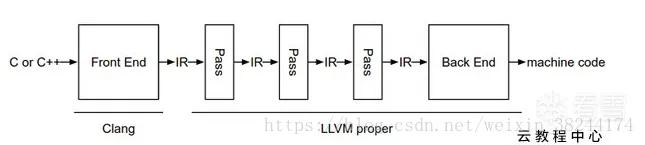
LLVM是一套编译器基础设施项目,分为前端、中间层标识(IR)、后端。
前端就包括Clang、Rustc等,前端负责将对应语言的源代码转为中间层代码(IR),后端负责将IR转为特定平台的机器码或汇编代码。
pass分类介绍
Pass,翻译是通过,通过一遍IR也就是遍历IR。在遍历IR的时候进行一些操作,比如优化、插桩、混淆。Pass的通常为.so文件。
分类:
- ModulePass 基于模块
- FunctionPass 基于函数
- CallGraphPass 基于调用图
- LoopPass 基于循环
functionPass
重点介绍一下functionPass,因为控制流平坦化的pass就是基于函数的
- 以函数为单位进行处理
- FunctionPass的子类必须实现runOnFunction函数
- 在FunctionPass运行时,会对程序中的每个函数执行runOnFunction函数
环境搭建
参考:https://bbs.kanxue.com/thread-279624.htm#msg_header_h2_1
OLLVM
可以这样理解,LLVM的pass是用来优化分析的,将这些pass的功能改为混淆代码,就是OLLVM项目。
IR
由于后面的pass编写都是针对IR指令的,所以我们有必要对它有更进一步的了解。
IR主要有两种表现形式:
- 人类可阅读的文本形式,对应后缀为 .ll
- 方便机器处理的二进制文本,对应后缀为 .bc
转换命令:
可阅读文本
1 | clang -S -emit-llvm fileName.c -o fileName.ll |
二进制
1 | clang -c -emit-llvm fileName.c -o fileName.bc |
这两种文件只是表现形式不同,均可以被优化编译成可执行文件。
Opt
opt为optimizer的缩写,优化器的意思,使用opt对IR进行优化操作。
1 | opt -load LLVMObfuscator.so -hlw -S fileName.ll -o fileName_opt.ll |
- -load 加载指定的Pass进行优化(.so文件)
- -hlw LLVM Pass中自定义的参数,用来指定使用Pass的哪些功能,这个例子就是启动高等级混淆。
- -S同前面clang参数的作用相同,生成可阅读文本。
流程
test.c --> test.ll --> test_opt.ll (可选)-> test
1 | clang fileName_opt.ll -o fileName |
编写一个简单的PASS入门
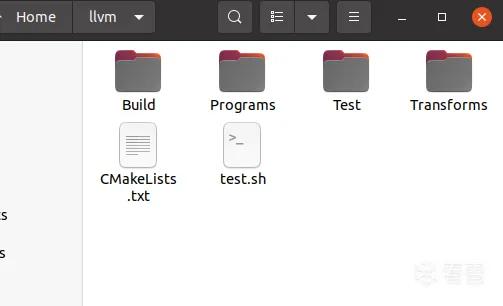
- Build存放生成的Pass
- Test文件夹存放测试程序
- Transforms/include存放LLVM Pass项目的头文件
- Transforms/src 存放Pass源码
- Transforms/CMakeLists.txt 整个CMake项目的配置文件。
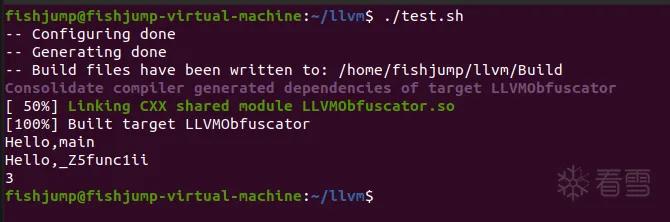
test.sh
1 2 3 4 5 6 7 8 | cd ./Buildcmake ../Transforms //对transforms的项目进行编译,得到编译后的`.so`文件make //得到pass.socd ../Testclang -S -emit-llvm TestProgram.cpp -o TestProgram.ll //clang将源代码转换为中间代码opt -load ../Build/LLVMObfuscator.so -hlw -S TestProgram.ll -o TestProgram_hlw.ll ////opt加载so文件,用hlw pass进行优化clang TestProgram_hlw.ll -o TestProgram_hlw //将优化后的中间代码编译为可执行文件./TestProgram_hlw //运行可执行文件 |
Test/Testprogram.cpp
1 2 3 4 5 6 7 8 9 10 11 12 13 14 15 16 17 18 19 20 | #include <cstdio>#include <cstring>int func1(int a,int b);int main(){ printf("%d\n",func1(1,2)); return 0;}int func1(int a,int b){ int result; if(a>0){ result=a+b; } else{ result=a-b; } return result;} |
Transforms/Helloworld.cpp
前面提到的在FunctionPass运行时,会对程序中的每个函数执行runOnFunction函数
1 2 3 4 5 6 7 8 9 10 11 12 13 14 15 16 17 18 19 20 21 22 23 24 25 26 27 28 | //在此编写LLVM Pass的代码 //导入llvm所需的头文件#include "llvm/Pass.h"#include "llvm/IR/Function.h"#include "llvm/Support/raw_ostream.h" //和输入输出有关using namespace llvm; //定义我们自己的命名空间namespace{ //首先需要继承FunctionPass class HelloWorld : public FunctionPass{ //自定义的HelloWorld类继承FunctionPass public: static char ID; HelloWorld() : FunctionPass(ID) {} //HelloWorld的构造函数 bool runOnFunction(Function &F); };} bool HelloWorld::runOnFunction(Function &F){ //todo 对函数的分析或修改代码 outs() << "Hello," << F.getName() << "\n"; //获取llvm的输出流} char HelloWorld::ID = 0;//注册static RegisterPass<HelloWorld> X("hlw","对Pass的描述"); //注册该Pass |
CMakeLists.txt
1 2 3 4 5 6 7 8 9 10 11 12 13 14 15 16 | # 参考官方文档:https://llvm.org/docs/CMake.html#developing-llvm-passes-out-of-sourceproject(OLLVM++) #项目名称 OLLVM++cmake_minimum_required(VERSION 3.13.4) #和llvm有关的环境变量find_package(LLVM REQUIRED CONFIG) list(APPEND CMAKE_MODULE_PATH "${LLVM_CMAKE_DIR}")include(AddLLVM)include_directories("./include") # 包含 ./include 文件夹中的头文件 separate_arguments(LLVM_DEFINITIONS_LIST NATIVE_COMMAND ${LLVM_DEFINITIONS})add_definitions(${LLVM_DEFINITIONS_LIST})include_directories(${LLVM_INCLUDE_DIRS}) add_llvm_library( LLVMObfuscator MODULE #注册LLVMObfuscator模块 src/HelloWorld.cpp #添加项目的源代码文件) |
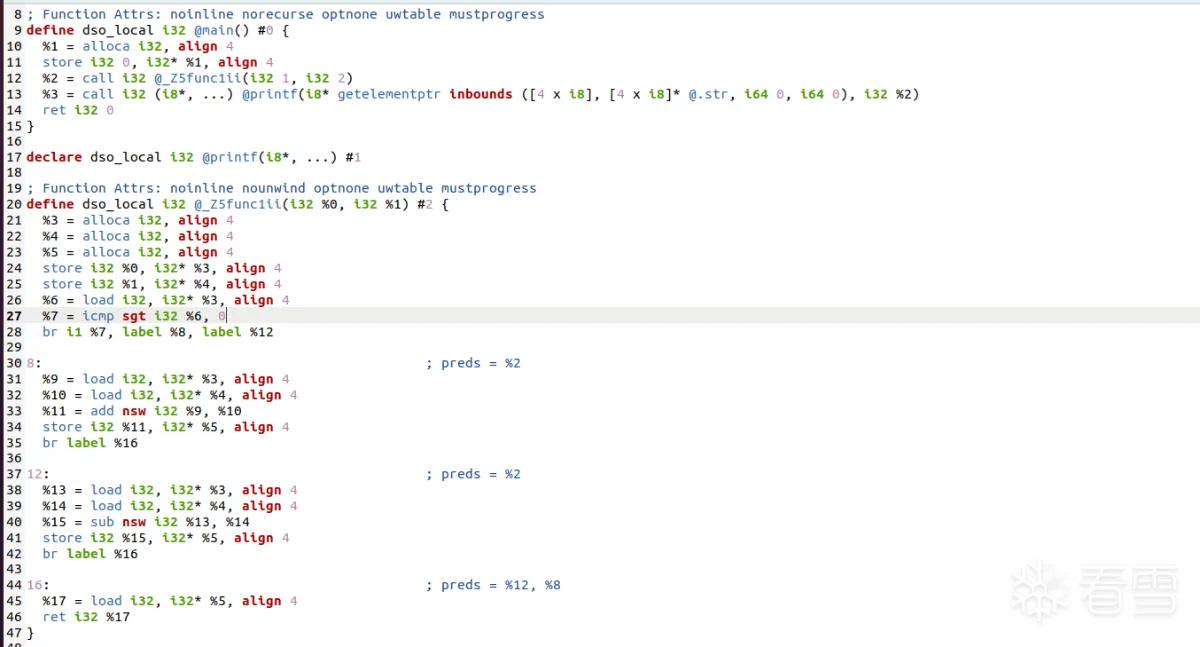
得到的.ll文件,和汇编语言很很相似
OLLVM控制流平坦化
简单介绍平坦化
顾名思义,就是让流程图平坦、扁平
源码
https://github.com/obfuscator-llvm/obfuscator/blob/llvm-4.0/lib/Transforms/Obfuscation/Flattening.cpp
正常的程序执行流程图
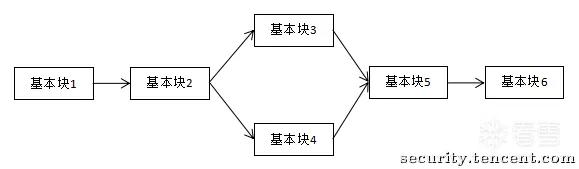
1 2 3 4 5 6 7 8 9 | 基本块1基本块2if(condition){ 基本块3}else{ 基本块4}基本块5基本块6 |
控制流平坦化之后的
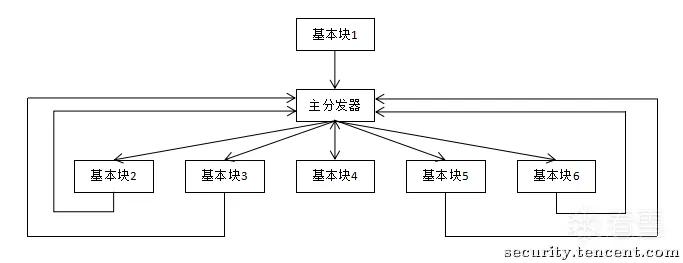
1 2 3 4 5 6 7 8 9 10 11 12 13 14 15 16 17 18 19 20 21 22 | 基本块1switchVar = 2;while(true){ switch(switchVar){ case 2: 基本块2 switchVar = condition ? 3 : 4; case 3: 基本块3 switchVar = 5 case 4: 基本块4 switchVar = 5 case 5: 基本块5 switchVar = 6 case 6: 基本块6 goto end; }}end: |
pass编写
下面开始控制流平坦化pass的编写
demo还是上面的Testprogram.cpp
编译成IR
1 | clang -S -emit-llvm TestProgram.cpp -o TestProgram.ll |
对应的流程图
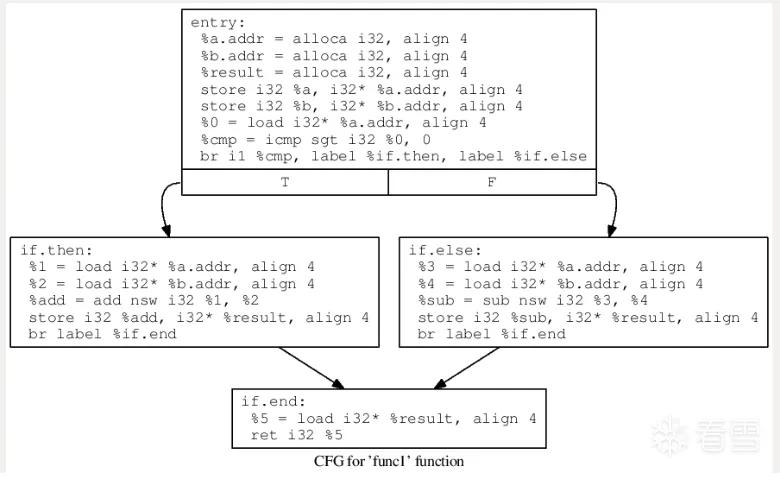
保存所有基本块
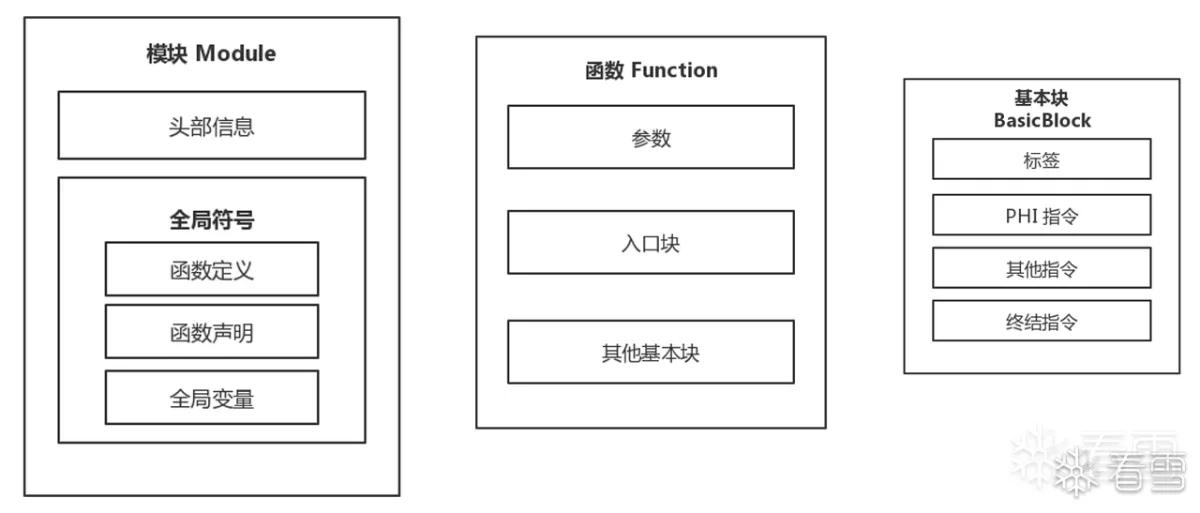
首先将本function中除了第一个BasicBlock的所有块保存到vector容器中,接着对bb的数量进行判断,当bb数量小于等于1时,flatten函数会直接退出并返回false。
1 2 3 4 5 6 7 8 9 10 11 12 13 14 15 16 17 18 19 20 | vector<BasicBlock*> origBB; //save all for(Function::iterator i=f->begin();i!=f->end();++i){ //address of bb BasicBlock *tmp=&*i; origBB.push_back(tmp); BasicBlock *bb=&*i; //if have invoke eg:call function if(isa<InvokeInst>(bb->getTerminator())){ return false; } } //outs() << "Hello," << origBB.size() << "\n"; //printf("\nsizeof origbb\n"); if(origBB.size()<=1){ return false; } |
接着通过F-begin获取本function的第一个bb,并将其从vector中擦除
1 2 | // Remove first BBorigBB.erase(origBB.begin()); |
分离第一个基本块
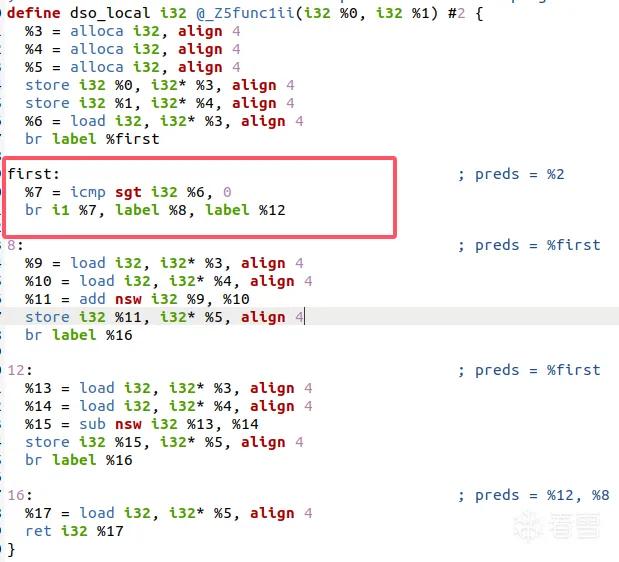
获取第一个BB进行特殊处理,首先会判断结尾是不是分支指令(必须是条件分支),如果是则把跳转的两个IR指令(类似汇编语言的cmp和jz jnz)单独分离作为一个基本块
1 2 3 4 5 6 7 8 9 10 11 12 13 14 15 16 17 18 19 20 21 22 23 24 25 26 | //Get a pointer on the first BBFunction::iterator tmp=f->begin();BasicBlock* entryBB=&*tmp;//if first bb have ifBranchInst*br=NULL;if(isa<BranchInst>(entryBB->getTerminator())){ //change type br=cast<BranchInst>(entryBB->getTerminator());}//ifif((br!=NULL&&br->isConditional())||entryBB->getTerminator()->getNumSuccessors()>1){ //cmp a,b ; jz lab ;xxx 这里则指向了xxx BasicBlock::iterator i=entryBB->end(); //point at jz --i; if(entryBB->size()>1){ //point at cmp --i; } //split bb from i and new bb named first BasicBlock *tmpBB=entryBB->splitBasicBlock(i,"first"); // insert firstBB to vector origBB.insert(origBB.begin(),tmpBB);} |
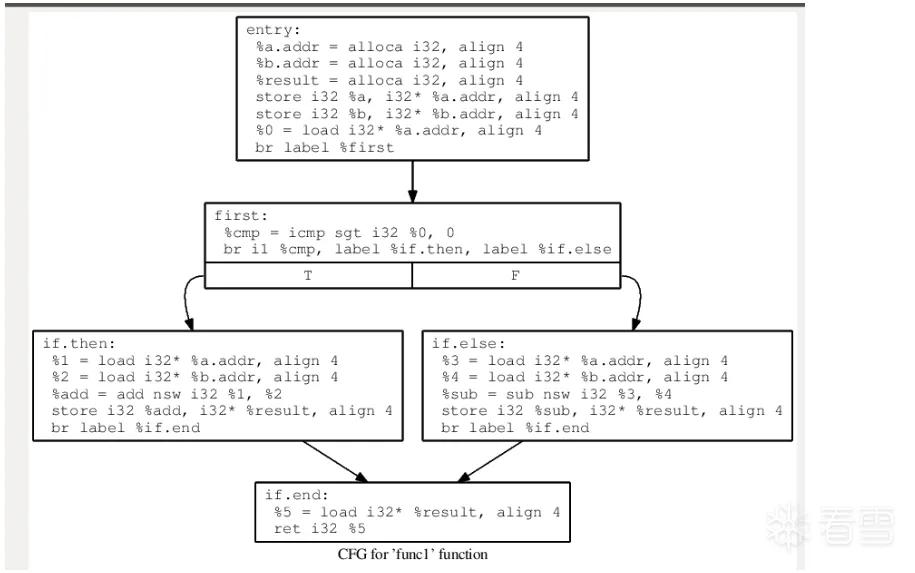
分割第一个基本块之后
对应的流程图
1 2 | //erase jump of entryentryBB->getTerminator()->eraseFromParent(); |
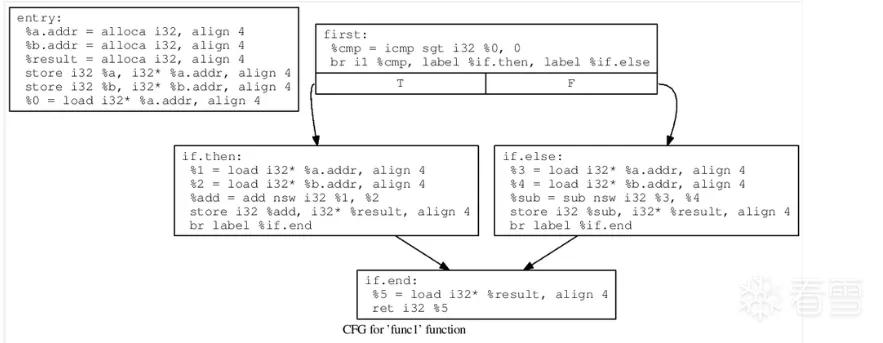
创建三个基本块switch case
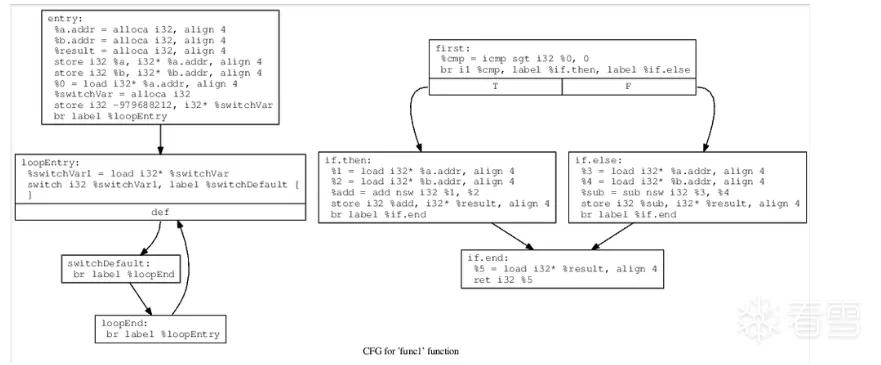
然后再第一个bb的末尾创建switchVar并赋予他一个随机的值,接着创建三个新的basicblock块,分别为loopEntry、loopEnd、swDefault,并设置好跳转关系
1 2 3 4 5 6 7 8 9 10 11 12 13 14 15 16 17 18 19 20 21 22 | //set swtich case srand(time(0)); int randNumCase=rand(); AllocaInst *swVarPtr = new AllocaInst(int32Type, 0, "swVar.ptr", entryBB); new StoreInst(ConstantInt::get(int32Type,randNumCase),swVarPtr,entryBB); // creat loopEntry loopEnd swDefault // name loopEntry , belong to BasicBlock f , location entryBB (end) BasicBlock *loopEntry= BasicBlock::Create(f->getContext(), "loopEntry", f, entryBB); BasicBlock *loopEnd= BasicBlock::Create(f->getContext(), "loopEnd", f, entryBB); BasicBlock *swDefault=BasicBlock::Create(f->getContext(),"swtichDefault",f,loopEnd); entryBB->moveBefore(loopEntry); //create swVar at loopEntry LoadInst *swVar = new LoadInst(int32Type, swVarPtr, "swVar", false, loopEntry); //entryBB-->loopEntry swDefault-->loopEnd BranchInst::Create(loopEntry,entryBB); BranchInst::Create(loopEnd,swDefault); BranchInst::Create(loopEntry,loopEnd); //create switch at loopEntry SwitchInst *switchI=SwitchInst::Create(swVar,swDefault,0,loopEntry); |
对应的流程图
将块加入swtch case语句
下面开始将vector中的每一个bb都添加到switch-case语句中,每一个bb对应一个case
1 2 3 4 5 6 7 8 9 10 11 12 | for(vector<BasicBlock*>::iterator b=origBB.begin();b!=origBB.end();++b) { BasicBlock *i=*b; ConstantInt *numCase=NULL; i->moveBefore(loopEnd); //case numCase : b i numCase=cast<ConstantInt>(ConstantInt::get(int32Type,randNumCase)); switchI->addCase(numCase,i); randNumCase=rand(); } |
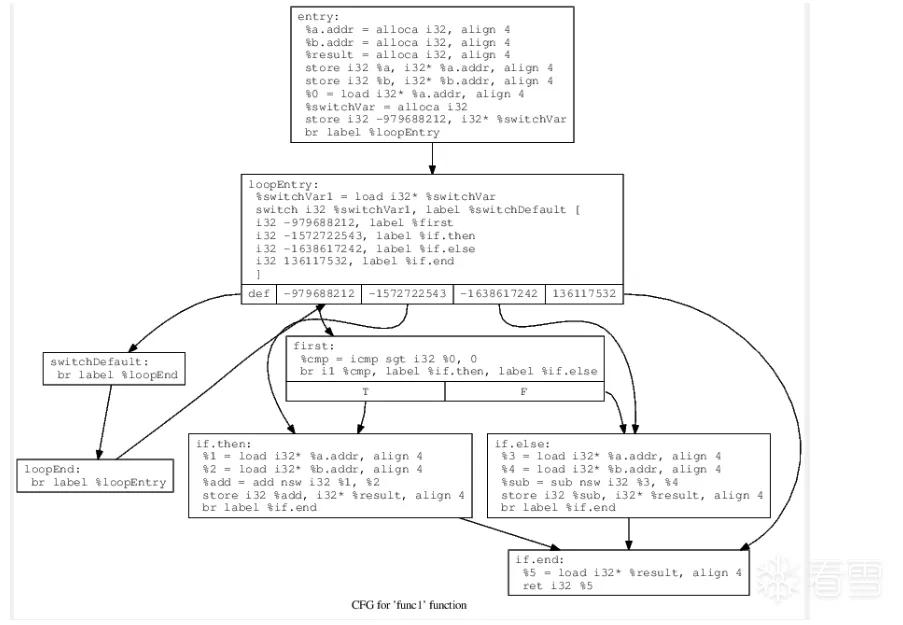
添加全部的basicblock块之后,还需要修复跳转关系,使得每个bb执行完之后,会重新设置switchVar,从而顺利跳转到下一个case。
分为三类来处理:
- 第一类为没有后继的,一般是以retn、call、exit结尾的基本块,不需要处理。
- 第二类,有一个后继,也就是非条件跳转,需要在末尾更新switchVar
- 第三类,有两个后继,也就是以条件跳转结尾的基本块,这类基本块需要插入select指令,类似于C语言的三元运算符
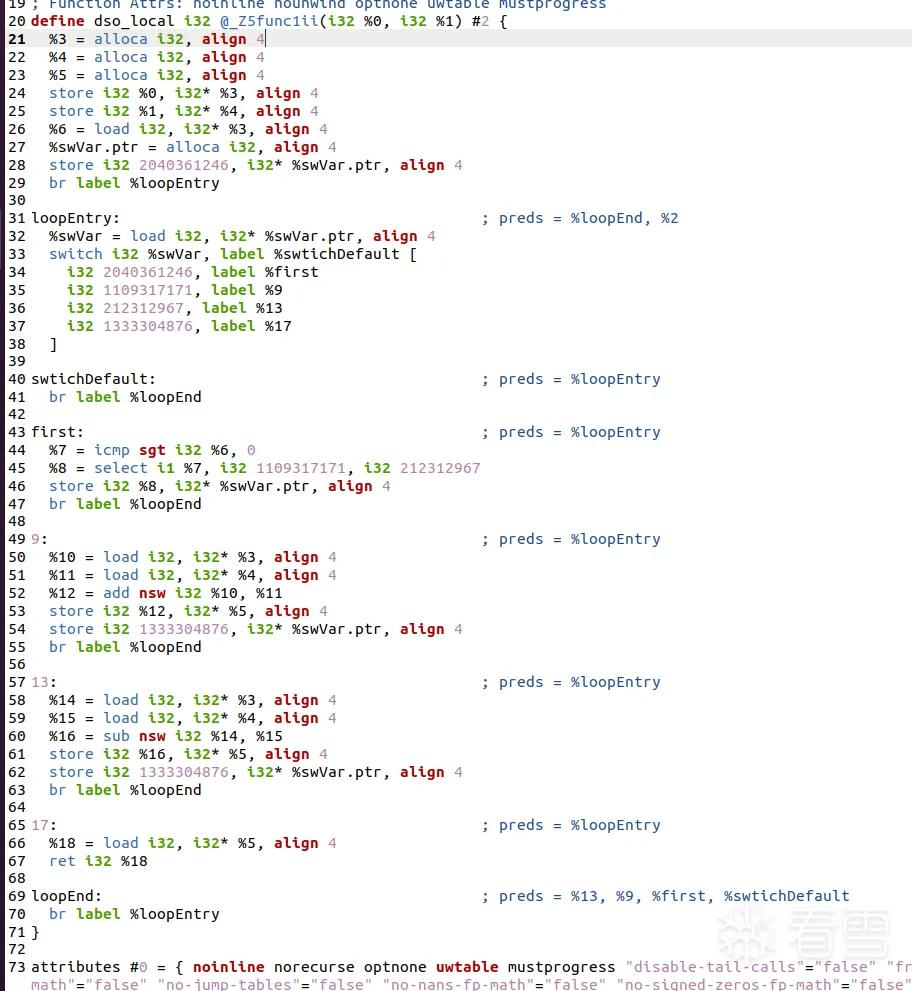
1 2 3 4 5 6 7 8 9 10 11 12 13 14 15 16 17 18 19 20 21 22 23 24 25 26 27 28 29 30 31 32 33 34 35 36 37 38 39 40 41 42 43 44 45 46 47 48 49 50 51 52 53 54 55 | for(vector<BasicBlock*>::iterator b=origBB.begin();b!=origBB.end();++b) { BasicBlock *i=*b; ConstantInt *numCase=NULL; i->moveBefore(loopEnd); //case numCase : b i numCase=cast<ConstantInt>(ConstantInt::get(int32Type,randNumCase)); switchI->addCase(numCase,i); randNumCase=rand(); } //three scenarios for(vector<BasicBlock*>::iterator b=origBB.begin();b!=origBB.end();++b) { BasicBlock*i=*b; ConstantInt*numCase=NULL; //no successor if(i->getTerminator()->getNumSuccessors()==0) { continue; } //non-conditional jump if(i->getTerminator()->getNumSuccessors()==1) { BasicBlock*succ=i->getTerminator()->getSuccessor(0); i->getTerminator()->eraseFromParent(); numCase=switchI->findCaseDest(succ); //set value at end new StoreInst(numCase,swVarPtr,i); BranchInst::Create(loopEnd,i); continue; } //conditional jump if(i->getTerminator()->getNumSuccessors()==2) { ConstantInt *numCaseTrue=switchI->findCaseDest(i->getTerminator()->getSuccessor(0)); ConstantInt *numCaseFalse=switchI->findCaseDest(i->getTerminator()->getSuccessor(1)); BranchInst *br=cast<BranchInst>(i->getTerminator()); //%sel = select i1 %condition, %numCaseTrue,%numCaseFalse SelectInst*sel=SelectInst::Create( br->getCondition(), numCaseTrue, numCaseFalse, "", i->getTerminator()); i->getTerminator()->eraseFromParent(); //update new StoreInst(sel,swVarPtr,i); BranchInst::Create(loopEnd,i); } } |
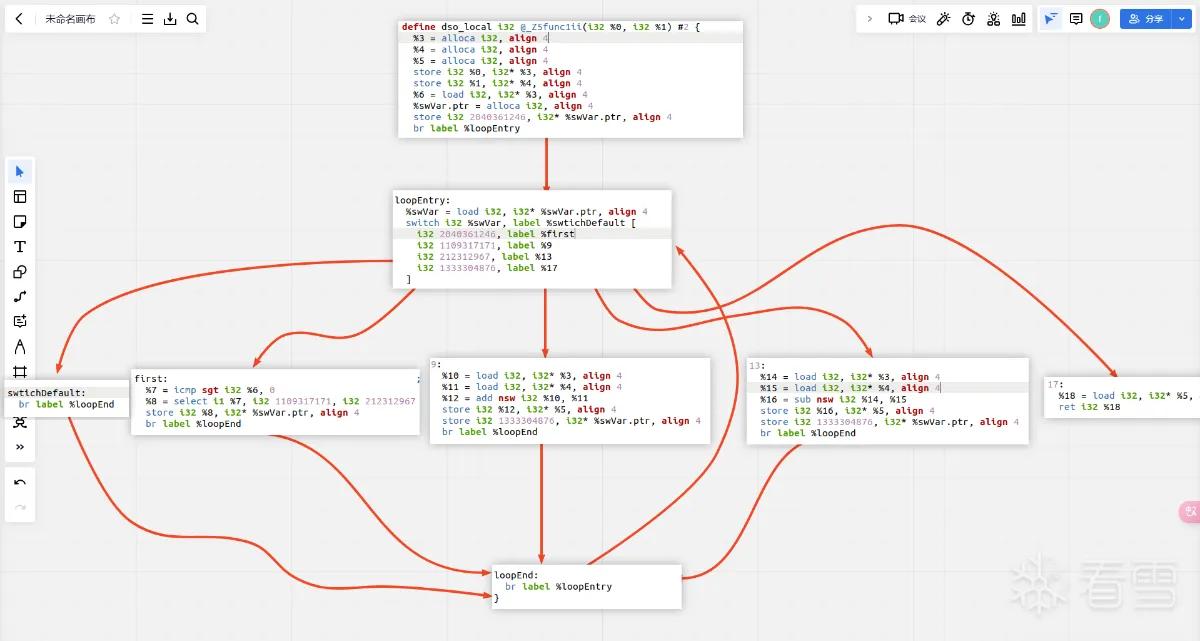
然后我们就能得到
对应的流程图就是
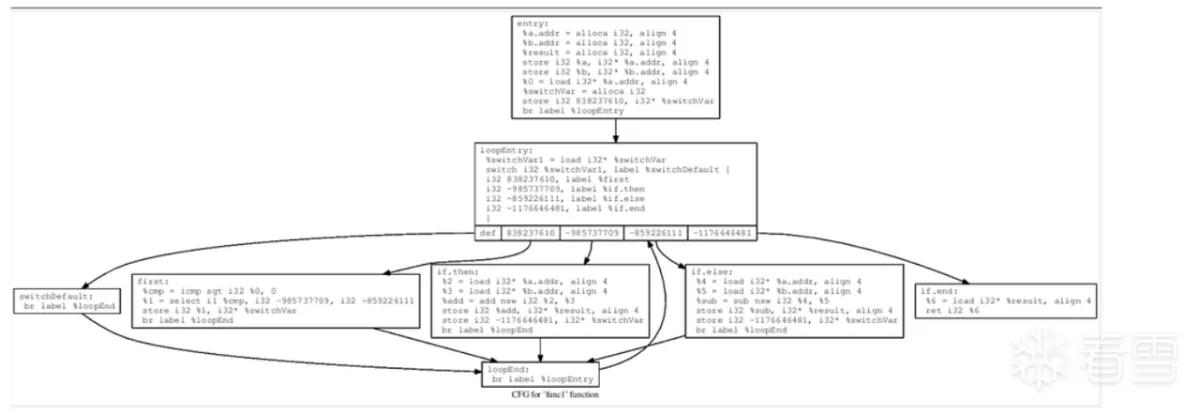
太糊了我画了一个>_<
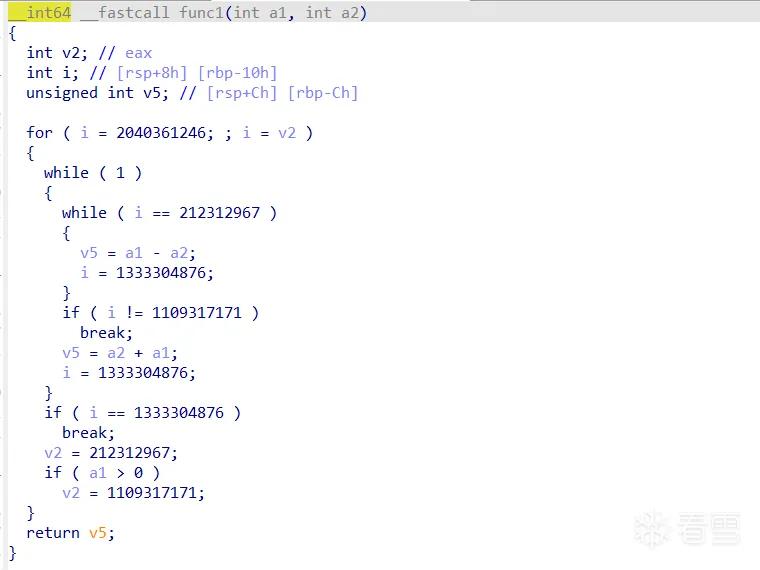
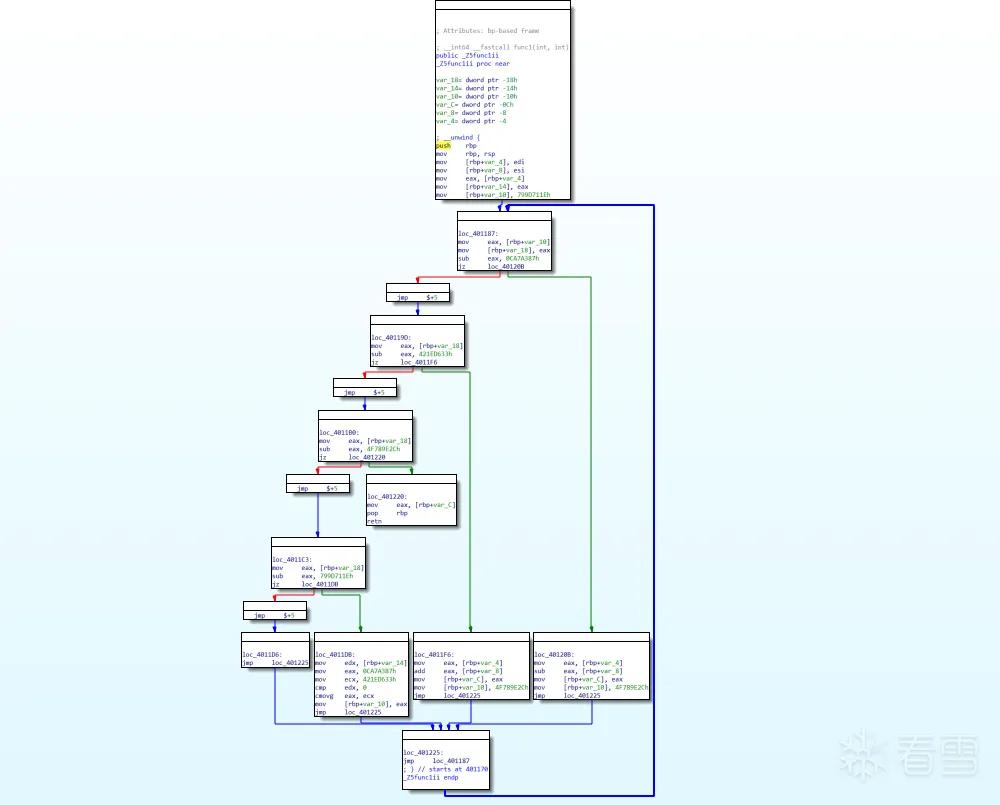
拖入ida看看效果
Next
下一篇的内容大概是控制流平坦化的对抗和魔改。
参考 ?
https://github.com/obfuscator-llvm/obfuscator/blob/llvm-4.0/lib/Transforms/Obfuscation/Flattening.cpp
https://bbs.kanxue.com/thread-279624.htm
https://bbs.kanxue.com/thread-282305.htm
https://www.cnblogs.com/BobHuang/p/17640378.html
https://bbs.kanxue.com/thread-255130.htm
https://bbs.kanxue.com/thread-266082.htm