前言
总结LLVM,OLLVM相关知识,自实现一个Pass,魔改OLLVM中的Pass,加深OLLVM的理解。
环境:LLVM 9.0、CMake:3.16.3
LLVM介绍及编译
LLVM介绍
首先介绍下LLVM是什么,借用下面的这张图说明一下,
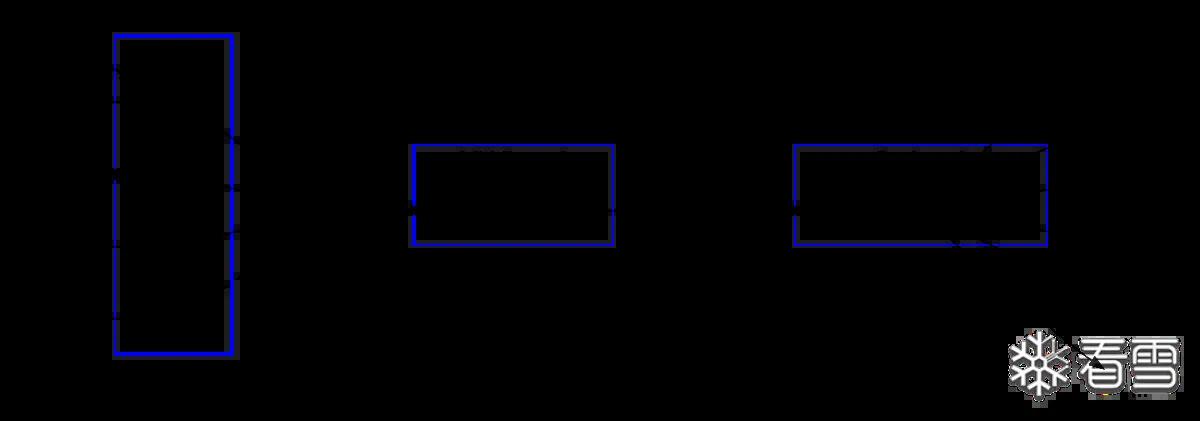
LLVM是一套编译器基础设施项目,分为前端后端和中间表示(IR Intermediate Representation),从图中可以看到有曾经用过的Clang,Clang就是llvm用于处理C和C++的前端。除了 Clang,LLVM还有支持其他语言的前端,例如 Rust、Swift、Python 等。这些前端会将对应语言的源代码转换成 LLVM 的中间表示,使得 LLVM 能够处理多种语言的编译需求。后端部分则负责将 LLVM IR转换成特定目标平台的机器码或汇编代码。
OLLVM 使用的就是 LLVM IR 来处理源代码,它能够获取到程序的结构和控制流信息,通过对这些信息的处理增强代码混淆的效果。
LLVM IR有两种文件格式.ll和.bc,.ll 文件和 .bc 文件都是 LLVM 中间表示的不同表示形式,.ll 文件是文本形式的可读表示,方便分析和调试;.bc 文件是二进制形式的紧凑表示,用于编译过程中的处理和优化,所以主要看.ll格式文件内容
再介绍一些IR相关的概念1.Pass是用于处理IR的关键组成部分,LLVM中自带的Pass主要是lib/Transforms中的.cpp文件2.IR结构,Module->Function->Basic Block->Instruction,这些是IR的不同层次结构从左到右是一对多的包含关系,而且从命名来看也比较好理解,Module对应.c文件内的整个源码,Function就是函数,Basic Block是基本块,每个基本块以一个终止指令(例如 ret、br 等)结尾,或者以一个无条件分支(如 br 指令)指向其他基本块,Instruction就是指令了,看一个ll文件内容:
1 2 3 4 5 6 7 8 9 10 11 12 13 14 15 16 17 18 19 20 21 22 23 24 | define dso_local i32 @main(i32 %argc, i8** %argv) #0 函数 {...first: ; preds = %loopEnd %.reload = load volatile i32, i32* %.reg2mem 指令 %cmp = icmp eq i32 %.reload, 2 %1 = select i1 %cmp, i32 769163483, i32 -1060808858 store i32 %1, i32* %switchVar br label %loopEndfirst就是一个名为first的基本块以br结尾if.then: S ; preds = %loopEnd2 %2 = load i8*, i8** %str, align 8 %3 = load i8*, i8** @globalString, align 8 %call = call i32 (i8*, ...) @printf(i8* getelementptr inbounds ([13 x i8], [13 x i8]* @.str.5, i64 0, i64 0), i8* %2, i8* %3) store i32 -1907967449, i32* %switchVar br label %loopEnd2if.else: ; preds = %loopEnd %4 = load i32, i32* %argc.addr, align 4 %cmp1 = icmp eq i32 %4, 3 %5 = select i1 %cmp1, i32 1950105811, i32 1575411630 store i32 %5, i32* %switchVar br label %loopEnd...} |
LLVM编译
安装并编译llvm,这里我选的是比较老的版本llvm 9.0,因为新版llvm更新了很多东西,包括最主要的PassManager,网上可参考资料比较少,而且只是学习ollvm的话学习思路比较重要。
1 | https://github.com/llvm/llvm-project/releases |
从官方的git库下载下来,之后编译,有两种一种是release版本一种是debug版本,普遍的说法是debug版本可用来调试自己写的Pass,在后面自己写Pass的时候感觉通过代码里打印的方式调试也还好,所以这里我编译的是release版。
编译没啥注意事项建文件打命令即可,-DLLVM_ENABLE_PROJECTS这个参数把clang编译了,后面要用到,这里还有一个常用的工具lldb这个调试Pass需要这个。
1 2 3 4 | cd到解压的文件夹里mkdir buildcd buildcmake -G Ninja -DCMAKE_BUILD_TYPE=release -DLLVM_ENABLE_PROJECTS="clang" ../llvm |
要编译几个小时,编译好之后,把编译后的bin文件路径加到环境变量里。
在源码外开发一个函数名变量名加密Pass
开发Pass,先简单配置一下编辑器的代码提示,我用的VsCode,首先在一级目录下建一个文件夹.vscode这个文件夹下建一个c_cpp_properties.json文件,内容为:
1 2 3 4 5 6 7 8 9 10 11 12 13 14 15 16 17 18 | { "configurations": [ { "name": "Linux", "includePath": [ "${workspaceFolder}/**", "{LLVM解压文件路径}/build_debug/include", "{LLVM解压文件路径}/llvm/include" ], "defines": [], "compilerPath": "/usr/bin/gcc", "cStandard": "c17", "cppStandard": "gnu++14", "intelliSenseMode": "linux-clang-x64" } ], "version": 4} |
准备好开发环境后,开始在源码外开发Pass,先按看官方文档中的流程建好文件。
1 | https://llvm.org/docs/CMake.html#developing-llvm-passes-out-of-source |
我配置的时候不同的是最外层的CMakeLists.txt,要根据报错自己加一些配置。
1 2 3 4 5 6 7 8 9 10 11 12 13 14 15 16 17 18 | cmake_minimum_required(VERSION 3.16)project(HelloPass)#这个可以随便取# 设置 LLVM 路径set(LLVM_DIR "{llvm源码路径}/build/lib/cmake/llvm")find_package(LLVM REQUIRED CONFIG)project(ProjectName)set(CMAKE_CXX_STANDARD 17)list(APPEND CMAKE_MODULE_PATH "${LLVM_CMAKE_DIR}")include(AddLLVM) //支持add_llvm_librarySET(CMAKE_CXX_FLAGS "-Wall -fno-rtti")separate_arguments(LLVM_DEFINITIONS_LIST NATIVE_COMMAND ${LLVM_DEFINITIONS})add_definitions(${LLVM_DEFINITIONS_LIST})include_directories(${LLVM_INCLUDE_DIRS})add_subdirectory(下级目录名) |
配置好后,写一个简单的函数名和变量名加密的Pass,实现方式主要是通过Module遍历Function,getName获取Function名后加密函数名,这里用MD5代替加密函数,之后通过setName再设置成加密后的函数名。变量名同理通过Module即可获取到所有变量名,这里以全局变量为例还是getName->加密->setName。
主体代码:
1 2 3 4 5 6 7 8 9 10 11 12 13 14 15 16 17 18 19 20 21 22 23 24 25 26 27 28 29 30 31 32 33 34 35 36 37 38 39 40 41 42 43 44 45 46 47 48 49 50 51 52 53 54 55 56 57 | namespace { struct EncodeFunctionName2 : public ModulePass { static char ID; EncodeFunctionName2() : ModulePass(ID) {} bool runOnFunction(Function &F) { Module *M = F.getParent(); LLVMContext &context = M->getContext(); errs() << "EncodeFunctionName: " << F.getName() << " -> "; if (F.getName().compare("main") != 0&&F.getName().compare("main") != 0) { llvm::MD5 Hasher; llvm::MD5::MD5Result Hash; Hasher.update("kanxue_"); Hasher.update(F.getName()); Hasher.final(Hash); SmallString<32> HexString; llvm::MD5::stringifyResult(Hash, HexString); F.setName(HexString); } errs() << F.getName() << "\r\n"; return true;//当修改了IR代码的话返回True } bool runOnModule(Module &M) override { llvm::MD5 Hasher; llvm::MD5::MD5Result Hash; for (auto &F : M) { runOnFunction(F); } for (GlobalVariable &GV : M.globals()) { StringRef oldName = GV.getName(); Hasher.update("kanxue_"); Hasher.update(oldName); Hasher.final(Hash); SmallString<32> HexString; llvm::MD5::stringifyResult(Hash, HexString); errs() << "EncodeVariableName: " << oldName << " -> "; // llvm::MD5::stringifyResult(Hash, HexString); // std::string newName = encryptName(oldName.str()); GV.setName(HexString); // modified = true; errs() << GV.getName() << "\r\n"; } return true; } };}char EncodeFunctionName2::ID = 0;//注册Passstatic RegisterPass<EncodeFunctionName2> X("encode", "Encode Function and Variable Name Pass", false /* Only looks at CFG */, false /* Analysis Pass */); |
在加密函数名时要注意跳过系统函数和main函数的加密。
使用opt工具生成.ll文件,opt在设置了环境变量后就能直接用,新版llvm加 -enable-new-pm=0。
opt -load "./EncodeFunctionName2/LLVMEncodeFunctionName2.so" --encode -S ../../hello.ll -o ../hello.ll

查看写的Pass里的参数选项
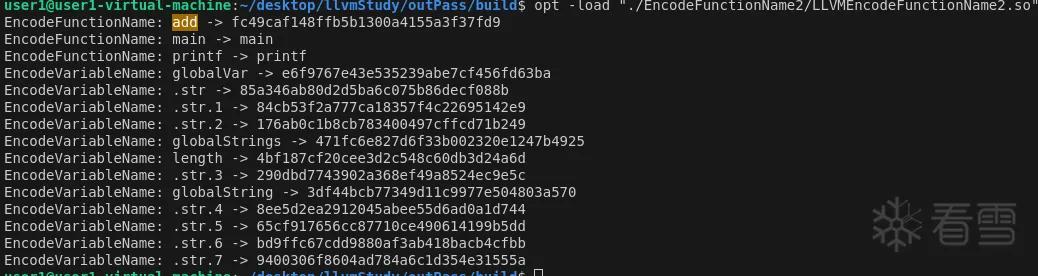
opt -load "./EncodeFunctionName2/LLVMEncodeFunctionName2.so" --help |grep encode

结果:
控制流平坦化分析及魔改
原版的OllVM在逆向的对抗中不断发展出了各种各样的反混淆方式,甚至都有了一键去平坦化的脚本,在分析过OLLVM的源码之后,我开始尝试对它进行简单的魔改,首先是控制流平坦化的Pass,在参考了网上大佬前辈的文章后我准备基于原版的控制流平坦化代码实现两个改进,一是不通过loopEntry分发loopEntry只作为入口,直接进入loopEnd,把分发流程做到loopEnd中,二是添加多个loopEnd,这样还能做到多个分发块。
先顺着原版的OLLVM代码说一下控制流平坦化的实现原理:
1 2 3 4 5 6 7 8 9 10 11 | bool Flattening::runOnFunction(Function &F) { Function *tmp = &F; // Do we obfuscate // if (toObfuscate(flag, tmp, "fla")) { if (flatten(tmp)) { ++Flattened; } // } return false;} |
首先运行的是runOnFunction,因为我是在源码树外开发的Pass所以把原版的参数判断代码注释了,主要调用了faltten函数
1 2 3 4 5 6 7 8 9 10 11 12 13 14 15 | vector<BasicBlock *> origBB;BasicBlock *loopEntry;BasicBlock *loopEnd;LoadInst *load;SwitchInst *switchI;AllocaInst *switchVar;// SCRAMBLERchar scrambling_key[16];llvm::cryptoutils->get_bytes(scrambling_key, 16);// END OF SCRAMBLER// Lower switch FunctionPass *lower = createLowerSwitchPass(); lower->runOnFunction(*f); |
这一段是生成用于加密的key和运行LowerSwitch函数,用于优化Switch语句,会把Switch语句变成更基础的控制流结构,如一系列的条件分支或跳转指令,说白了就是会改变逻辑把代码结果变得更复杂,这是LLVM自带的Pass,也算是一次混淆了。
1 2 3 4 5 6 7 8 9 10 11 12 13 14 15 16 17 18 19 20 21 22 23 24 25 26 27 28 29 30 31 32 33 34 35 36 37 38 39 40 41 42 43 44 | // Save all original BB for (Function::iterator i = f->begin(); i != f->end(); ++i) { BasicBlock *tmp = &*i; origBB.push_back(tmp); BasicBlock *bb = &*i; if (isa<InvokeInst>(bb->getTerminator())) { return false; } } // Nothing to flatten if (origBB.size() <= 1) { return false; } // Remove first BB origBB.erase(origBB.begin()); // Get a pointer on the first BB Function::iterator tmp = f->begin(); //++tmp; BasicBlock *insert = &*tmp; // If main begin with an if BranchInst *br = NULL; if (isa<BranchInst>(insert->getTerminator())) { br = cast<BranchInst>(insert->getTerminator()); } if ((br != NULL && br->isConditional()) || insert->getTerminator()->getNumSuccessors() > 1) { BasicBlock::iterator i = insert->end(); --i;// 指令多大于一可能还有cmp指令所以要和跳转指令一起分割 if (insert->size() > 1) { --i; } BasicBlock *tmpBB = insert->splitBasicBlock(i, "first"); origBB.insert(origBB.begin(), tmpBB); } // Remove jump 移除掉splitBasicBlock函数分割后第一个块跳转到frist块的指令。 insert->getTerminator()->eraseFromParent(); |
这一段主要是保存一份所有原始的代码块,在原始代码块被修改时方便取用,之后把原始代码块中的第一个入口代码块和后面的代码分割开,这样做的目的是为了插入loopEntry这个用于分发的代码块,再通过loopEntry和后面的代码块连接起来并且把入口块用于跳转的指令独立分割成一个名为first的块加入到loopEntry分发中,。
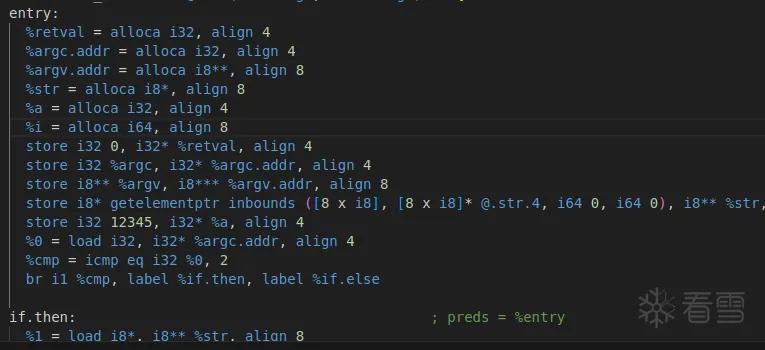
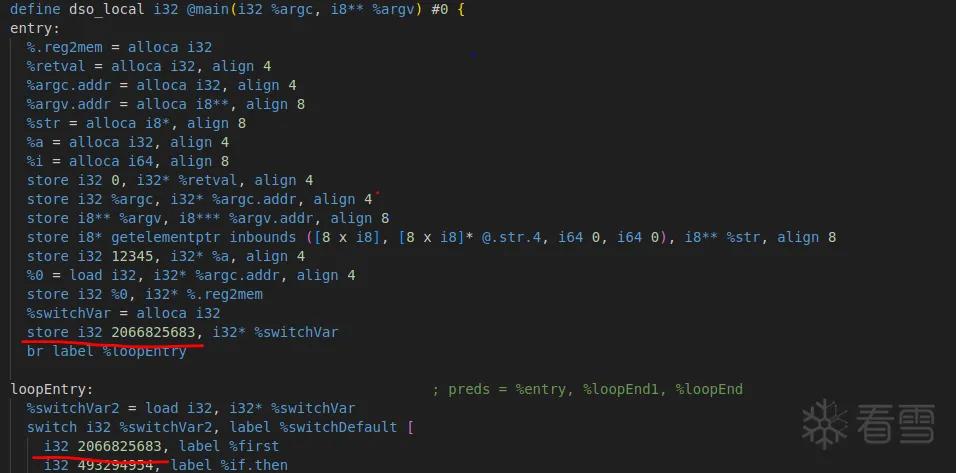
类似这样,entry作为入口代码块平坦化后会设置switchVar为first对应的switchVar,再通过first来进入第二个代码块,这样就不能直接看出正常逻辑entry之后该执行的真实代码块是哪个了
1 2 3 4 5 6 7 8 9 10 11 12 13 14 15 16 17 18 19 20 21 22 23 24 25 26 27 28 29 30 31 32 33 34 35 36 37 38 39 40 41 42 43 44 45 46 47 48 49 50 | // Create switch variable and set as it 创建switchVar变量并设置一个随机生成的值switchVar = new AllocaInst(Type::getInt32Ty(f->getContext()), 0, "switchVar", insert);new StoreInst( ConstantInt::get(Type::getInt32Ty(f->getContext()), llvm::cryptoutils->scramble32(0, scrambling_key)), switchVar, insert);// Create main loop 第三个参数是插入在哪个块之前loopEntry = BasicBlock::Create(f->getContext(), "loopEntry", f, insert);loopEnd = BasicBlock::Create(f->getContext(), "loopEnd", f, insert);load = new LoadInst(switchVar, "switchVar", loopEntry);// Move first BB on topinsert->moveBefore(loopEntry);BranchInst::Create(loopEntry, insert);// loopEnd jump to loopEntryBranchInst::Create(loopEntry, loopEnd);BasicBlock *swDefault = BasicBlock::Create(f->getContext(), "switchDefault", f, loopEnd);BranchInst::Create(loopEnd, swDefault);// Create switch instruction itself and set conditionswitchI = SwitchInst::Create(&*f->begin(), swDefault, 0, loopEntry);switchI->setCondition(load);// Remove branch jump from 1st BB and make a jump to the whilef->begin()->getTerminator()->eraseFromParent();BranchInst::Create(loopEntry, &*f->begin());// Put all BB in the switchfor (vector<BasicBlock *>::iterator b = origBB.begin(); b != origBB.end(); ++b) { BasicBlock *i = *b; ConstantInt *numCase = NULL; // Move the BB inside the switch (only visual, no code logic) i->moveBefore(loopEnd); // Add case to switch //llvm::cryptoutils->scramble32这个函数的第一个参数是加密字段,第二个是key,switchI->getNumCases的值是从0开始递增那这里生成的跳转条件就和llvm::cryptoutils->scramble32(0, scrambling_key)是一样的 numCase = cast<ConstantInt>(ConstantInt::get( switchI->getCondition()->getType(), llvm::cryptoutils->scramble32(switchI->getNumCases(), scrambling_key))); switchI->addCase(numCase,i);} |
这一段是用于生成loopEntry,loopEnd,switchDefault三个代码块,在loopEntry中添加一个switch语句,并以SwitchVar存储条件值,原始代码块通过赋值这个变量即可完成跳转,并遍历所有原始代码块,以switch结构中目前case的个数进行加密得到的数字作为case的条件,就是0,1,2,3...挨个加密所以不会出现重复的case条件,再把跳转原始基本块的条件加入到switch语句中。
1 2 3 4 5 6 7 8 9 10 11 12 13 14 15 16 17 18 19 20 21 22 23 24 25 26 27 28 29 30 31 32 33 34 35 36 37 38 39 40 41 42 43 44 45 46 47 48 49 50 51 52 53 54 55 56 57 58 59 60 61 62 63 64 65 66 67 68 69 70 71 72 73 | // Recalculate switchVar 这里开始遍历所有块去除块中最后的brfor (vector<BasicBlock *>::iterator b = origBB.begin(); b != origBB.end(); ++b) { BasicBlock *i = *b; ConstantInt *numCase = NULL; // Ret BB if (i->getTerminator()->getNumSuccessors() == 0) { continue; } if (i->getTerminator()->getNumSuccessors() == 1) {//1个的类似if{} 判断是一个block条件为真后的代码是一个代码块 // Get successor and delete terminator BasicBlock *succ = i->getTerminator()->getSuccessor(0); i->getTerminator()->eraseFromParent(); // Get next case numCase = switchI->findCaseDest(succ); // If next case == default case (switchDefault) if (numCase == NULL) { numCase = cast<ConstantInt>( ConstantInt::get(switchI->getCondition()->getType(), llvm::cryptoutils->scramble32( switchI->getNumCases() - 1, scrambling_key))); } // Update switchVar and jump to the end of loop new StoreInst(numCase, load->getPointerOperand(), i); BranchInst::Create(loopEnd, i); continue; } // If it's a conditional jump if (i->getTerminator()->getNumSuccessors() == 2) { //有两个的类似if(){}else{} // Get next cases ConstantInt *numCaseTrue = switchI->findCaseDest(i->getTerminator()->getSuccessor(0)); ConstantInt *numCaseFalse = switchI->findCaseDest(i->getTerminator()->getSuccessor(1)); // Check if next case == default case (switchDefault) if (numCaseTrue == NULL) { numCaseTrue = cast<ConstantInt>( ConstantInt::get(switchI->getCondition()->getType(), llvm::cryptoutils->scramble32( switchI->getNumCases() - 1, scrambling_key))); } if (numCaseFalse == NULL) { numCaseFalse = cast<ConstantInt>( ConstantInt::get(switchI->getCondition()->getType(), llvm::cryptoutils->scramble32( switchI->getNumCases() - 1, scrambling_key))); } // Create a SelectInst BranchInst *br = cast<BranchInst>(i->getTerminator()); SelectInst *sel = SelectInst::Create(br->getCondition(), numCaseTrue, numCaseFalse, "", i->getTerminator()); // Erase terminator i->getTerminator()->eraseFromParent(); // Update switchVar and jump to the end of loop new StoreInst(sel, load->getPointerOperand(), i); BranchInst::Create(loopEnd, i); continue; }}fixStack(f);return true; |
最后这段代码完成收尾工作,之前已经把loopEntry中的switch跳转做好了,但是原始代码块的最后的跳转还是原来的逻辑,这一块还没有处理,主要做两点通过原来的跳转指令获取要跳转到的代码块,再通过switchI->findCaseDest获取到是对应哪个Case,把Case的条件赋值给switchVar,这里就可以移除原始跳转指令了,再添加一个跳转loopEnd的指令,loopEnd会跳转到loopEntry,这样进入Switch分发器了,最后修复PHI和堆栈,fixStack这一块和这次魔改没太大关系就不说了。
接下来开始实现之前说的两个改进,首先是不通过loopEntry分发loopEntry只作为入口,直接进入loopEnd,把分发流程做到loopEnd中
,这里要做的是把switch生成到loopEnd中,然后把loopEnd跳转loopEntry的跳转指令删除掉,这样就可以实现loopEnd直接分发代码块
1 2 3 4 5 6 7 8 9 10 11 12 13 14 15 16 17 18 19 | LoadInst *load2 = new LoadInst(switchVar, "switchVar", loopEnd); BasicBlock *swDefault = BasicBlock::Create(f->getContext(), "switchDefault", f, loopEnd); BranchInst::Create(loopEnd, swDefault);SwitchInst *switch2=SwitchInst::Create(load2, loopEnd2, 0, loopEnd); //修改查找Case的switch为loopEnd里的switch numCase = switch2->findCaseDest(succ) 生成的LR loopEnd: ; preds = %for.end, %for.body, %if.else5, %if.else, %first, %loopEnd2, %switchDefault %switchVar2 = load i32, i32* %switchVar switch i32 %switchVar2, label %loopEnd2 [ i32 -256601636, label %first i32 -1060808858, label %if.else i32 1575411630, label %if.else5 i32 1213754259, label %for.body i32 420055895, label %for.end i32 -1907967449, label %if.end9 ] |
二是添加多个loopEnd,这里要改的部分比较多,因为不只一个分发块的情况下每个分发块的平分了所有代码块,这里就要保证当一个代码块进入了这个分发块的时候如果switchVar的条件值可以找到对应的Case,类似下图这样。
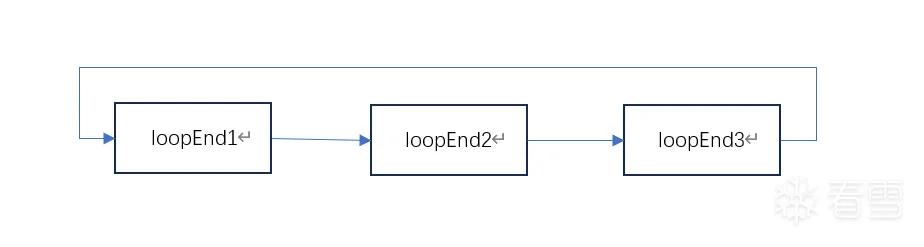
和只有一个分发块不同的就是要把switch的默认跳转设置成下一个loopEnd在最后一个loopEnd把默认跳转设置成第一个loopEnd,这次魔改我用了两个loopEnd,想多一点可以写成循环。
1 2 3 | SwitchInst *switch2=SwitchInst::Create(load2, loopEnd2, 0, loopEnd);SwitchInst *switch3=SwitchInst::Create(load3, loopEnd, 0, loopEnd2); |
接下来是把所有代码块的跳转平分给两个loopEnd,
1 2 3 4 5 6 7 8 9 10 11 12 13 14 15 16 17 18 19 20 21 22 23 24 25 26 27 28 29 | int addCase_flag=1; size_t count1=0; for (vector<BasicBlock *>::iterator b = origBB.begin(); b != origBB.end(); ++b,count1++) { BasicBlock *i = *b; ConstantInt *numCase = NULL; // Move the BB inside the switch (only visual, no code logic) i->moveBefore(loopEnd); //change if(addCase_flag==1){ // Add case to switch numCase = cast<ConstantInt>(ConstantInt::get( switchI->getCondition()->getType(), llvm::cryptoutils->scramble32(count1, scrambling_key))); switch2->addCase(numCase, i); addCase_flag=0; } else{ // Add case to switch numCase = cast<ConstantInt>(ConstantInt::get( switchI->getCondition()->getType(), llvm::cryptoutils->scramble32(count1, scrambling_key))); switch3->addCase(numCase, i); addCase_flag=1; } //change // switch2->addCase(numCase, i); } |
以及最后去除原始代码块跳转添加判断跳转Case值的修改,这里用了一个判断,来判断这个分发块中是否包含了Case条件值没有就查找下一个分发块。
1 2 3 4 5 6 7 8 9 10 11 12 13 14 15 16 17 18 19 20 21 22 23 24 25 26 27 28 29 30 31 32 33 34 35 36 37 38 39 40 41 42 43 44 45 46 47 48 49 50 51 52 53 54 55 56 57 58 59 60 61 62 63 64 65 66 67 68 69 70 71 72 73 74 75 76 77 78 79 80 81 82 83 84 85 86 87 88 89 90 91 92 93 94 95 96 97 98 99 100 101 102 103 104 105 106 107 108 109 110 111 112 | size_t conut2=0;int a=1;for (vector<BasicBlock *>::iterator b = origBB.begin(); b != origBB.end(); ++b,conut2++) { BasicBlock *i = *b; ConstantInt *numCase = NULL; // Ret BB if (i->getTerminator()->getNumSuccessors() == 0) { continue; } // If it's a non-conditional jump if (i->getTerminator()->getNumSuccessors() == 1) { // Get successor and delete terminator BasicBlock *succ = i->getTerminator()->getSuccessor(0); i->getTerminator()->eraseFromParent(); // Get next case if(switch2->findCaseDest(succ)!=nullptr) {numCase = switch2->findCaseDest(succ);} else {numCase = switch3->findCaseDest(succ);} // If next case == default case (switchDefault) if (numCase == NULL) { numCase = cast<ConstantInt>( ConstantInt::get(switchI->getCondition()->getType(), llvm::cryptoutils->scramble32( switchI->getNumCases() - 1, scrambling_key))); } // Update switchVar and jump to the end of loop new StoreInst(numCase, load->getPointerOperand(), i); if(a==1){ BranchInst::Create(loopEnd, i); a=0; } else{ BranchInst::Create(loopEnd2, i); a=1; } // BranchInst::Create(loopEnd, i); continue; } // If it's a conditional jump if (i->getTerminator()->getNumSuccessors() == 2) { // Get next cases ConstantInt *numCaseTrue =nullptr; ConstantInt *numCaseFalse =nullptr; if(switch2->findCaseDest(i->getTerminator()->getSuccessor(0))!=nullptr) { numCaseTrue = switch2->findCaseDest(i->getTerminator()->getSuccessor(0)); } else { numCaseTrue = switch3->findCaseDest(i->getTerminator()->getSuccessor(0)); } if(switch2->findCaseDest(i->getTerminator()->getSuccessor(1))!=nullptr) { numCaseFalse = switch2->findCaseDest(i->getTerminator()->getSuccessor(1)); } else { numCaseFalse = switch3->findCaseDest(i->getTerminator()->getSuccessor(1)); } // Check if next case == default case (switchDefault) if (numCaseTrue == NULL) { numCaseTrue = cast<ConstantInt>( ConstantInt::get(switchI->getCondition()->getType(), llvm::cryptoutils->scramble32( switchI->getNumCases() - 1, scrambling_key))); } if (numCaseFalse == NULL) { numCaseFalse = cast<ConstantInt>( ConstantInt::get(switchI->getCondition()->getType(), llvm::cryptoutils->scramble32( switchI->getNumCases() - 1, scrambling_key))); } // Create a SelectInst BranchInst *br = cast<BranchInst>(i->getTerminator()); SelectInst *sel = SelectInst::Create(br->getCondition(), numCaseTrue, numCaseFalse, "", i->getTerminator()); // Erase terminator i->getTerminator()->eraseFromParent(); // Update switchVar and jump to the end of loop new StoreInst(sel, load->getPointerOperand(), i); if(a==1){ BranchInst::Create(loopEnd, i); a=0; } else{ BranchInst::Create(loopEnd2, i); a=1; } continue; }} |
看下效果:
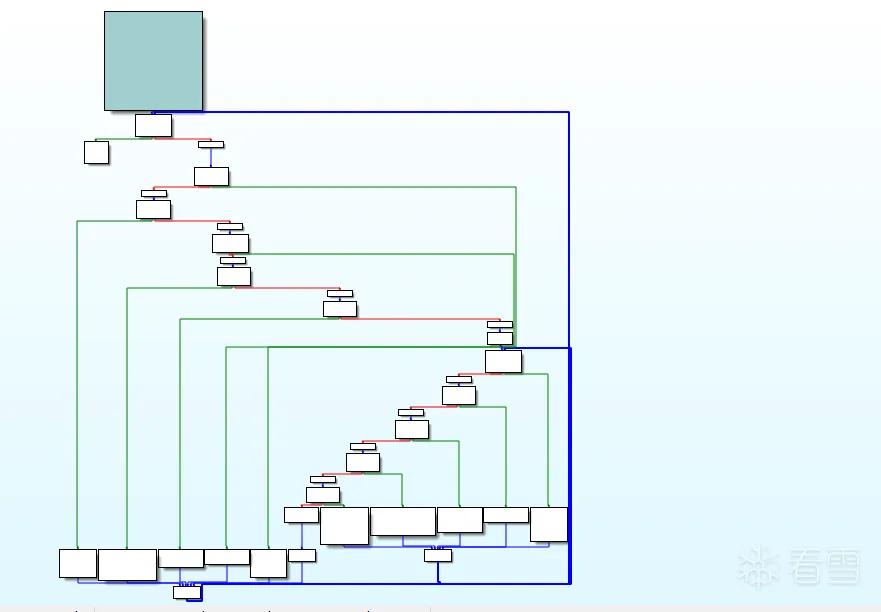
可以看到现在有两个loopEnd分发块且入度基本相同,并且由于是直接跳转到基本块,流程图里的两个loopEnd各会有一条不同的路径返回到不同的块,这样通过LoopEntry的前继也获取不到所有的loopEnd了。
不过对于OLLVM来说控制流平坦化只是其中的一环,配合OLLVM中的其他模块或一些的新型混淆Pass才能发挥最大的作用。
参考文章
https://xuanxuanblingbling.github.io/ctf/pwn/2019/12/21/llvm/
https://leadroyal.cn/p/1072/
http://www.qfrost.com/posts/llvm/llvmflattening%E6%BA%90%E7%A0%81%E5%88%86%E6%9E%90/#%E5%A4%8D%E6%9D%82%E5%88%86%E5%8F%91%E8%BF%87%E7%A8%8B
https://groups.google.com/g/llvm-dev/c/-ihkMNlDvEQ